What Is a Phinisi? The Bugis Schooner Behind Every Komodo Charter
What is a phinisi boat? The Bugis-Konjo schooner explained: its South Sulawesi origins, the UNESCO-listed craft behind it, and how it rules Komodo.
7 min read
What is a phinisi? The Bugis schooner behind every Komodo charter
A phinisi is a traditional two-masted wooden sailing vessel developed by the Bugis, Makassar and Konjo boatbuilding communities of South Sulawesi. UNESCO inscribed the art of pinisi boatbuilding in 2017. Modern charter phinisi keep the rig and silhouette but run on engines, carrying ensuite cabins through Komodo.
By Yohanes Sanggu, journal editor. Reviewed by Kristoforus Jehamat, Fleet Director.
Stand on the Labuan Bajo waterfront at dusk and nearly every silhouette on the anchorage answers the same description: high bow, two raked masts, long wooden sheer. Guests ask what is a phinisi boat expecting a one-line answer, and the honest one takes a page, because the word carries five centuries of trade, a UNESCO listing and a modern charter industry on its back. Here is the full answer, from the desk that curates a phinisi charter fleet out of that same harbor.
A definition worth being precise about
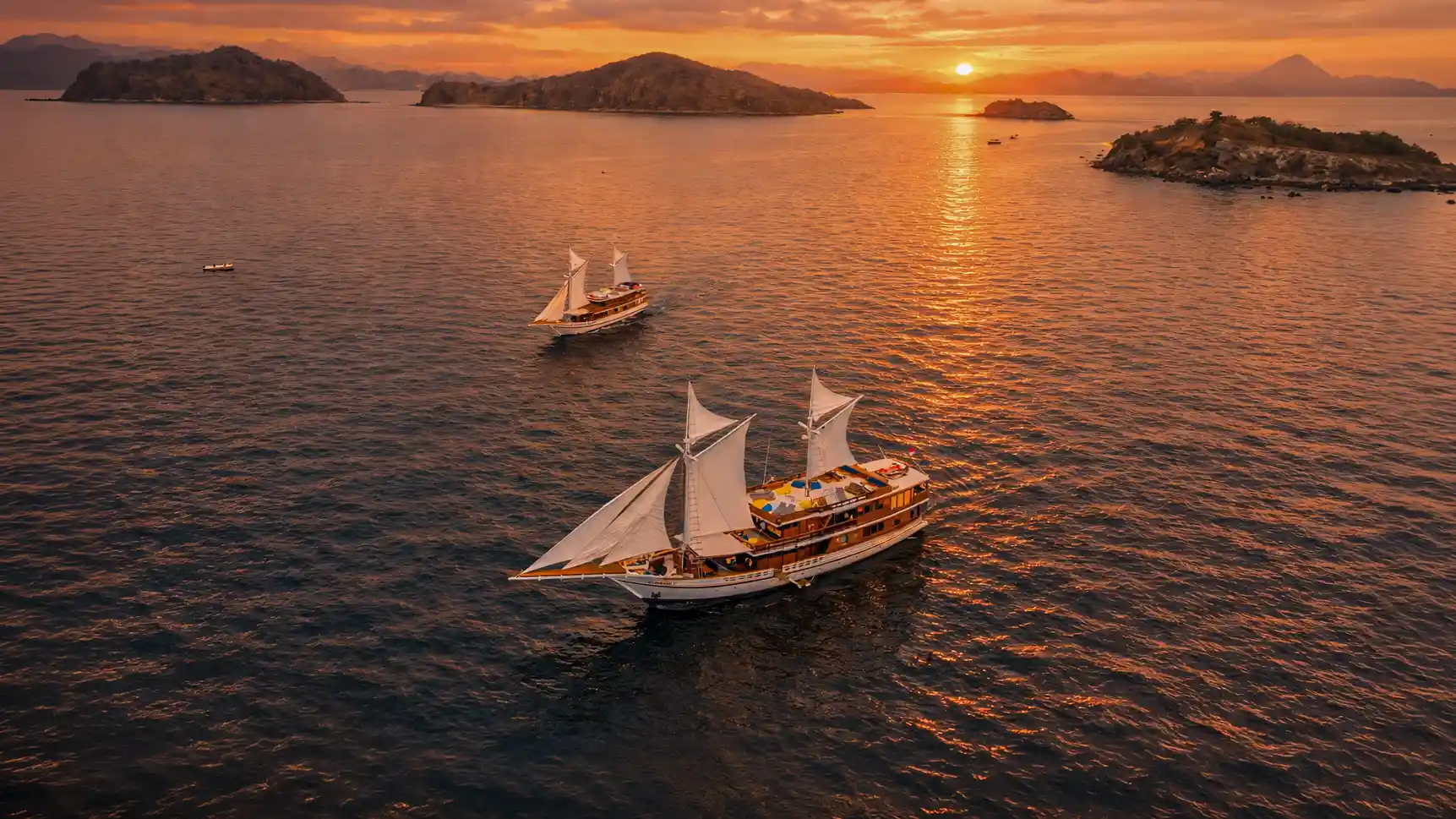
Strictly speaking, pinisi names a rig, not a hull: a two-masted layout carrying, in its classic form, seven sails, with gaff-rigged mains and a bank of headsails run to a long bowsprit. The hulls beneath that rig were traditional South Sulawesi types built for cargo. Over time, common usage moved the word onto the boats themselves, and today phinisi means the broad-shouldered wooden motor-sailer you see across Indonesian waters. Both spellings circulate; pinisi is closer to the Sulawesi original, phinisi is what the charter world writes.
Where phinisi come from
The craft belongs to the Konjo, Bugis and Makassar boatbuilding communities of Bulukumba regency at the southern tip of Sulawesi, centered on the villages of Ara, Tana Beru and Lemo-Lemo near Bira. Hulls are still raised there on open beaches: keel first, planks shaped by eye and adze, fastened with wooden pegs, the frames fitted into a shell that already holds its shape, the reverse of Western practice. Master builders inherit the proportions rather than drawing them, and launches remain ceremonial affairs for the whole village.
In 2017 UNESCO inscribed this tradition, under the name Pinisi, art of boatbuilding in South Sulawesi, on the Representative List of the Intangible Cultural Heritage of Humanity. The listing recognizes the knowledge and the community that carries it, which is why a genuine phinisi is less a product than a lineage: many of the hulls now anchored off Labuan Bajo were shaped on those same Bulukumba beaches.
From cargo schooner to charter icon
For generations phinisi were the trucks of the archipelago, hauling timber, rice and copra between islands under sail alone. Engines arrived in the second half of the twentieth century and the pure sailing fleet shrank, but the hulls never stopped being built. What changed their fate was tourism: the same seaworthy wooden volume that once carried cargo converts beautifully into cabins, saloons and sun decks. As Komodo National Park rose into a world destination, Labuan Bajo became the densest phinisi charter harbor anywhere, and the schooner silhouette turned into the park’s second logo after the dragon itself. Trips to Komodo Island now begin, almost by default, on a hull whose design predates the park by centuries.
What a modern charter phinisi actually is
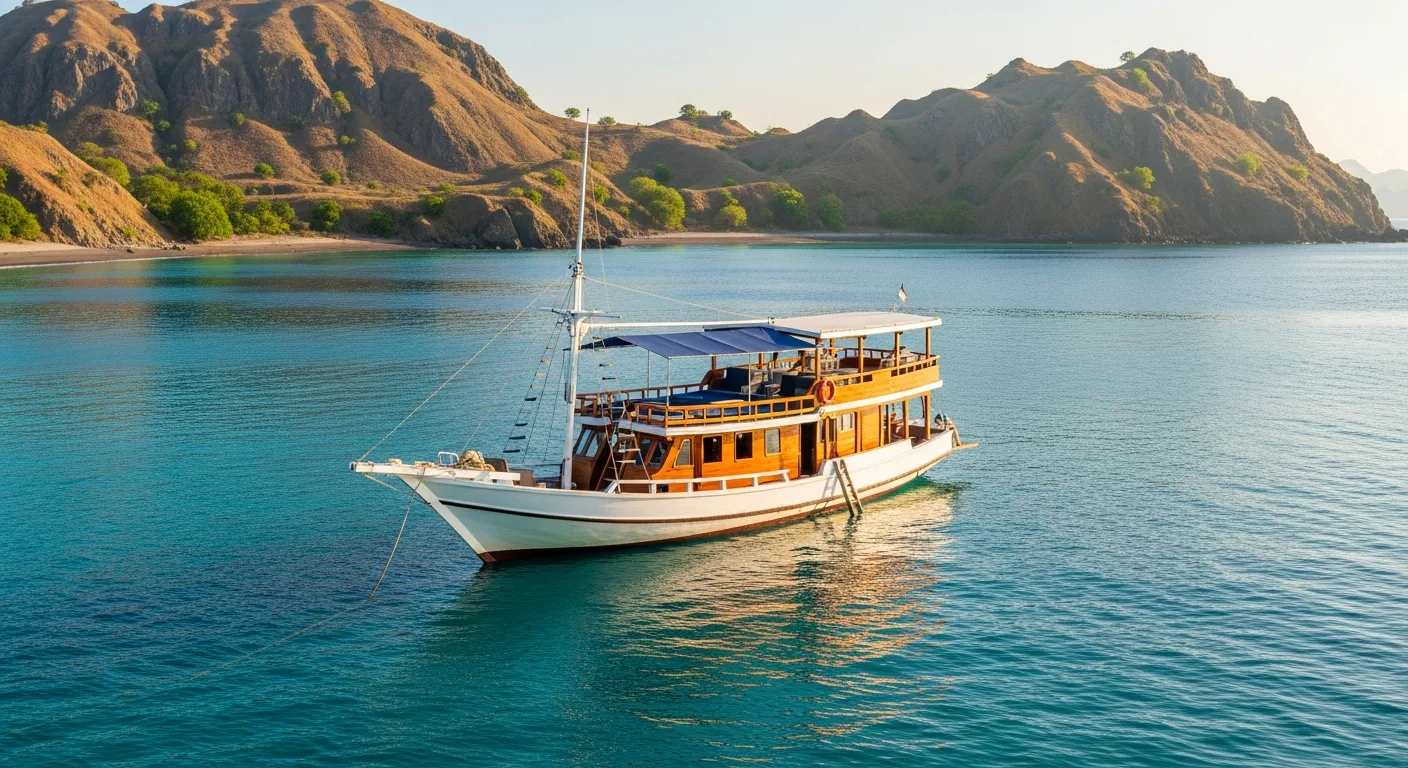
Underneath the heritage, today’s charter phinisi is a purpose-built or purpose-converted liveaboard: ironwood and teak construction, diesel engine as primary propulsion, masts and sails retained in varying degrees of sincerity, and interiors that range from simple bunks to full suites. The scale in our directory tells the story. Semesta Voyage runs 32 meters with eight air-conditioned ensuite suites and Starlink internet; Raffles Cruise stretches 33 meters with six ocean-view cabins, built in 2023 and launched in April 2025, proof the Bulukumba yards are busier than ever; Andalucia 2 holds the middle at 26.5 meters with six cabins for sixteen guests. Same ancestry, three different price bands, one recognizable profile on the horizon.
How to read a phinisi listing
Four fields tell you most of what matters. Length drives presence and deck space. Cabin count against guest capacity tells you how the boat will feel when full: eight cabins for sixteen guests promises privacy, five cabins for twenty-five promises noise. Class, whether standard, deluxe or luxury, sets the comfort hardware, a ladder we break down fully in our phinisi class guide. And pricing basis matters most of all: whole-boat charter versus per-person cabin rates are different products on the same hull. A typical 3D2N charter is the format most phinisi are scheduled around, which makes it the cleanest basis for comparing boats.
Do they still sail?
Honestly: mostly no. Engines do the daily work, because park schedules and anchorage slots do not wait for wind. Many crews hoist canvas for photographs, a passage-making few sail in earnest when the monsoon cooperates, and the masts always earn their keep as architecture. If sailing under canvas is the point of your trip rather than a bonus, say so at booking, and the desk will point you to the hulls and the season, covered in our best time to sail guide, where it genuinely happens. The curation team behind Komodo Luxury boards and grades every vessel we list, sails included.
The seven sails, named by function
The classic rig that defined the type carries seven sails in three working groups: two large gaff-rigged mainsails on the fore and main masts doing the heavy pulling, topsails set above them for light air, and a run of three headsails stretched to the long bowsprit for balance and steering. The layout let a small crew manage a large cargo hull across open water, which was the whole point. On modern charter boats the count is often reduced and the canvas newer than the tradition implies, but stand on the foredeck of any phinisi and the geometry of that old rig is still what you are looking at: the raked masts, the bowsprit reaching over the anchor, the sheer line built for a load.
Why wood still wins in this park
There are practical reasons the fleet never switched to fiberglass. A heavy wooden hull rides Komodo’s chop with a slow, settled motion that suits sleep at anchor. The material shades and breathes in a way molded hulls do not, decks stay walkable barefoot, and repairs happen in local yards with local skills rather than imported parts. Add the economics, since Bulukumba builds to order at a fraction of a comparable steel yacht, and the tradition turns out to be the rational choice as well as the romantic one. The silhouette being the best advertisement in the harbor costs nothing extra.
Questions we hear at the desk
Are phinisi boats safe for overnight trips?
A maintained, documented phinisi is a proven overnight platform; these hulls were built for weeks at sea, not afternoons. What separates the fleet is upkeep and crew, which is exactly what our grading checks: papers, safety equipment, and the state of the boat the day we board it, not the day it was photographed.
What is the difference between a phinisi and a yacht?
Material, motion and mood. A phinisi is wood, roomy and unhurried; a modern yacht is fiberglass or steel, faster and more clinical. The full trade-off, including speed and budget math, is in our phinisi versus yacht comparison.
How many people fit on a phinisi?
Across our directory, roughly ten guests on intimate four-cabin boats up to the high twenties on big shared-departure hulls. The comfortable number is always the cabin count times two; anything past that relies on extra beds. More sizing questions are answered in the charter FAQ.
Want the schooner, not just the story? Message the fleet desk on WhatsApp at (+62) 811 3823 875 or email [email protected] with your dates and group size, and we will match you to a hull whose builders we could name.