4D3N Komodo Charter — First Unlock: South Komodo (Oct–Apr)
4D3N Komodo boat charter: signature loop plus south Komodo swing. Day-by-day itinerary, per-night pricing $9,000–$90,000, Oct–Apr vs May–Sep guide.
18 min read
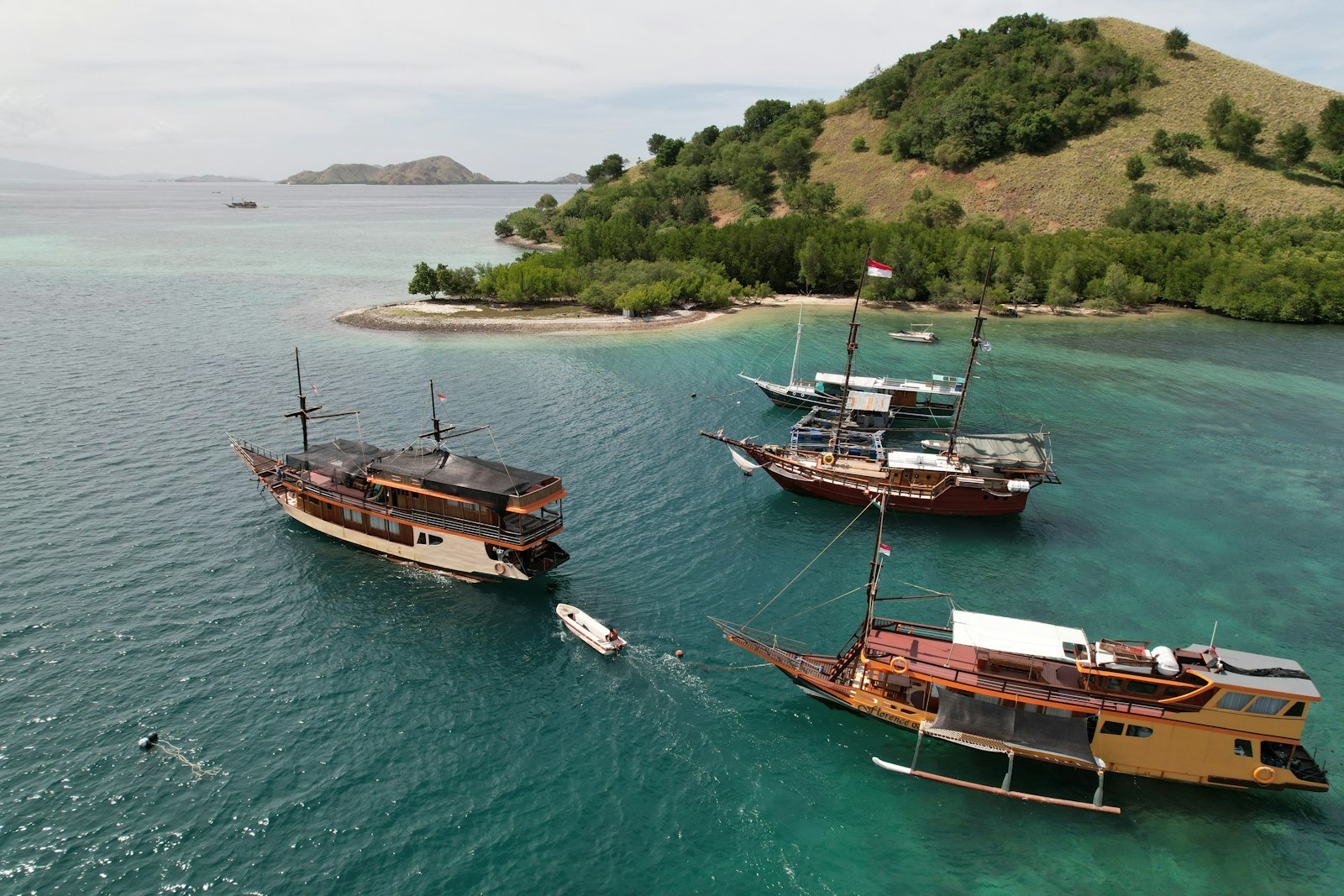
A 4D3N Komodo boat charter — four days and three nights departing from Labuan Bajo into Komodo National Park — is the first duration on the charter ladder where the south coast opens up. Two nights gets you the postcard circuit. Three nights lets you swing south around Rinca to Horseshoe Bay, add Cannibal Rock to your dive log, and still finish with a morning at Karang Makassar for mantas before the 17:00 return to Labuan Bajo. That extra night is the whole difference.
This is the itinerary I design most often for couples who want Komodo unrushed, for certified divers who want a genuine taste of the park across eight to ten dives, and for families willing to follow the gentler year-round variant. Below is the full day-by-day breakdown, honest season notes, and the per-night math.
What the 4D3N Itinerary Unlocks That Shorter Trips Cannot
The 2D1N charter gives you one dragon site, Padar at sunrise, and mantas. The 3D2N adds both dragon islands and a night at Gili Lawa Darat. The moment you add a third night, the route geometry changes entirely. There is now enough time to loop south of Rinca — past Padar’s southern tip to Horseshoe Bay (Loh Dasami) — without sacrificing the north sites on the way home. October through April, when the northwest monsoon calms the southern approaches, that swing is the reason people extend from three nights to four.
For divers specifically, the difference is concrete: a 3D2N liveaboard nets five or six dives if you push the pace. The 4D3N private phinisi charter, done right, puts eight to ten dives on your log — including Cannibal Rock, which ranks among the most species-rich coral walls in eastern Indonesia. You cannot reach Cannibal Rock on a two-night charter and return to Labuan Bajo without overnight sailing that most guests find unpleasant.
Day-by-Day Komodo 4D3N Itinerary
Day 1 — Kelor, Rinca Dragons, and the Kalong Bat Flight
Depart Labuan Bajo between 08:00 and 09:00 — early enough that you reach Kelor Island before the tour-boat crowd. The hill trek takes twenty minutes and the view across to Padar and Komodo is the first thing that tells guests the park is genuinely different from what they imagined. Snorkel the reef below the headland; the hard coral here is healthy and the light at this hour is ideal.
From Kelor, the sail southeast to Rinca’s Loh Buaya takes roughly ninety minutes to two hours. The ranger-guided dragon walk is not optional — Komodo dragons are wild apex predators, and the regulation requiring a guide exists for good reason. The walk usually takes an hour. Dragons are most active in the morning heat rather than the midday peak, so the timing works well. After Rinca, sail to Kalong Island in time for dusk. A colony of tens of thousands of flying foxes lifts from the tree canopy just before sunset — one of those things that photographs poorly and stays with you for years. Anchor overnight near Kalong.
Day 2 (Oct–Apr) — Padar Sunrise, then South to Horseshoe Bay
Wake before dawn. The sail from Kalong to Padar takes an hour and a half to two hours at phinisi speed — the crew will have coffee and breakfast ready on deck in the dark. The Padar sunrise trek is forty-five minutes up a rocky path; go at your own pace, the ridge waits for no one but the light does hold for fifteen minutes after sunrise if you need a moment at the top. The view — three bays, three different colors of sand, the island’s spine dropping to the sea on both sides — is the image associated with Komodo National Park more than any other.
After Padar, the October–April itinerary turns south. This is the swing that the 4 days 3 nights komodo tour is built around. The sail around the southern tip of Rinca to Horseshoe Bay takes two to three hours. Horseshoe Bay (Loh Dasami) is sheltered, quiet, and very different from the northern anchorages — darker water, denser forest, a beach where Komodo dragons wander freely without the ranger infrastructure of Loh Buaya. You observe them from the tender, not from a designated trail. Cannibal Rock sits just off the bay; an afternoon dive or snorkel here typically yields lionfish, pygmy seahorses, massive gorgonian sea fans, and schooling fish so dense they block the light. Anchor overnight in Horseshoe Bay.
Day 2 (May–Sep) — Pink Beach and Komodo Island Dragons
From Padar, sail northeast to Pink Beach. The pink colouration comes from fragments of red coral mixed into the white sand — it deepens in afternoon light. Snorkel the reef in front; the turtle count here is reliable. Then sail to Komodo Island’s Loh Liang ranger station for the afternoon dragon trek. A second dragon encounter after Rinca is not repetition — Loh Liang is a different environment, and the dragons at Loh Liang tend to be larger. Anchor near Loh Liang or continue north toward Gili Lawa for the evening.
Day 3 (Oct–Apr) — Yellow Wall, Manta Alley, and the Dragon Trek
Dawn dive or snorkel at Yellow Wall, the seamount wall on the eastern edge of Horseshoe Bay. The current here runs hard and cold — water temperatures in the south in this season can drop into the low twenties Celsius — which is precisely what feeds the color and density of life on the wall. This is a site for confident swimmers and certified divers; the crew will assess conditions before committing.
If swell and current allow, the boat will make the three-hour run west to Manta Alley (Torpedo Bay). I want to be clear about this: Manta Alley is not a guarantee. It is an attempt, made when the conditions and the captain’s judgment align. The manta cleaning stations here are most active during the wet season plankton bloom, which is why the October–April window exists as a product at all. When it works — and it often does — you spend an hour in clear water with oceanic mantas circling a cleaning station below. When it does not, the crew sails directly north.
From the south, the sail north to Komodo Island’s Loh Liang takes three to four hours. Arrive for the dragon trek in the late afternoon — dragons are often more visible near the ranger buildings at this hour, warming on the cleared paths. Continue north to anchor at Gili Lawa Darat. The sunset ridge hike here takes twenty minutes and overlooks the northern park waters; it is a calmer, smaller view than Padar but rewards anyone who makes the walk.
Day 3 (May–Sep) — Castle Rock and Crystal Rock, Gili Lawa
The May–September variant substitutes the south leg entirely with the northern dive sites. Castle Rock and Crystal Rock — seamounts in the northern park — are considered among the best current-dive sites in Indonesia when the conditions cooperate. White-tip and grey reef sharks, schooling barracuda, giant trevally, and the occasional hammerhead in season. This is the reason some divers prefer the dry-season charter: the northern sites are at their visibility peak and the sea state is manageable if breezy. Anchor at Gili Lawa Darat for the evening; the sunset ridge walk is the same.
Day 4 — Karang Makassar Mantas, Taka Makassar Sandbar, Labuan Bajo
The last morning. Sail to Karang Makassar — also called Manta Point — for a drift snorkel or dive over the cleaning station. Unlike Manta Alley in the south, mantas are present at Karang Makassar throughout the year; the hit-rate here is the best in the park regardless of season, with December through March offering the highest encounter probability as plankton density peaks. After the manta drift, the boat anchors briefly at Taka Makassar — a tidal sandbar that appears and disappears with the tide, white against clear water, invariably the photograph that ends every charter.
A final snorkel stop at Sebayur or Kanawa, then the three-and-a-half to four-hour run back to Labuan Bajo. The boat is alongside the pier by 17:00.
Season Guide: South Komodo vs. North Circuit
The seasonal logic of this komodo 4d3n itinerary is worth understanding before you book, not after.
- October–April (Northwest Monsoon)
- South Komodo is accessible. Horseshoe Bay, Cannibal Rock, Yellow Wall, and a Manta Alley attempt are all within range. January and February are the wettest months — rain arrives in short squalls and rarely cancels a full day, but keep plans flexible. This is the signature version of the four-day charter.
- May–September (Southeast Trades)
- The southeast trade winds build swell on the south coast. Horseshoe Bay becomes uncomfortable to unreachable, and attempting Manta Alley would mean a rough beam-sea passage that most guests find miserable. We do not sell the south swing in this season. The northern circuit — Crystal Rock, Castle Rock, Gili Lawa — is at its best instead, with glassy mornings and excellent vis on the dive sites. July and August are the peak-crowd months in the park; expect more boats at the popular spots.
- Mantas at Karang Makassar
- Year-round, with highest encounter rates December–March. Manta Alley (south) peaks during the wet-season plankton bloom, roughly November–April. These are two different sites with two different seasonal profiles — the facts file behind our recommendations distinguishes them carefully.
- Park Access
- Komodo National Park operates an advance-booking requirement through the SiORA ticketing system. Visitor entry is reportedly capped at 1,000 per day (single-source figure — verify at booking). KSOP Labuan Bajo can suspend sailing permits during extreme weather warnings issued by BMKG; this has occurred in prior seasons. Your operator handles permit logistics, but closures are a real contingency and your charter contract should address them.
Who This Duration Suits
Couples Wanting the Full Park Without Rushing
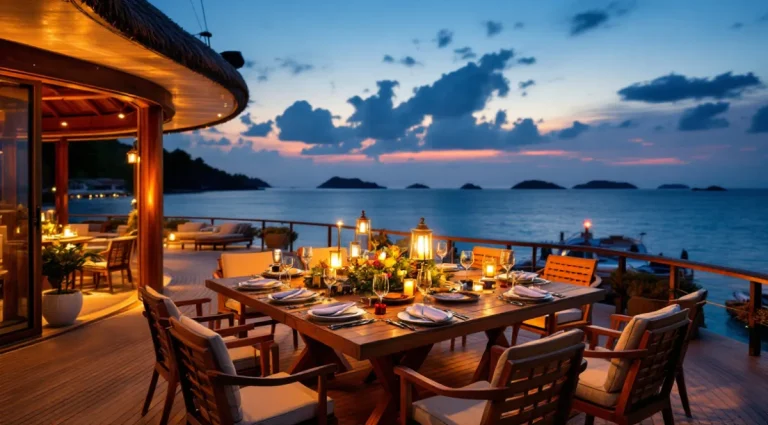
The 3D2N charter is the honeymoon standard — everything once, nothing repeated. If you want to linger at Padar until the light changes, spend a second hour watching dragons at Loh Buaya, or have the morning at Horseshoe Bay entirely to yourselves, three nights is the minimum to do it without the itinerary feeling like a checklist. For honeymooners specifically, the private-charter structure means the boat is yours: beach dinners, private sundowner decks, and a master cabin are standard on mid-range and luxury phinisi vessels. Add-ons like floral arrangements or champagne on arrival are arranged through the concierge brief.
Certified Divers Getting a Real Taste
Eight to ten dives across the four days is realistic at a pace of two or three per day: Kelor reef, Manjarite, Cannibal Rock (twice — morning and afternoon is standard), Yellow Wall, Manta Alley, Karang Makassar, and either Crystal/Castle Rock or a second south site depending on season. That covers the cold-water south walls and the central manta drift in one charter. A full open-water certification is required; advanced OW is recommended for Cannibal Rock and the northern current sites. Dive equipment is typically extra even when tanks and a compressor are aboard — confirm nitrox availability and guide inclusion when you build the brief.
Families with the May–Sep Variant
The north circuit is the family version of this trip. Pink Beach has calm, shallow water appropriate for younger swimmers. The Loh Buaya dragon walk is structured and ranger-guided. Taka Makassar is a sandbar — the definition of accessible. If the kids want a rest day, the itinerary can absorb a slower pace at Sebayur without losing the key sites. Komodo’s currents are real and require adult supervision at all dive and snorkel stops; the crew will brief you on which sites are appropriate for different ages. Children under twelve are typically not cleared for the current dive sites.
Vessel Classes and Per-Night Budget Transparency
Three nights of private charter in Komodo National Park from Labuan Bajo spans a wide range depending on the vessel class. The market quotes per-trip packages rather than clean nightly rates, so what follows are implied per-night figures derived from current market data (last verified June 2026).
| Vessel Class | Typical Cabins | Typical Guests | Implied Per Night | 4D3N Total (3 nights) |
|---|---|---|---|---|
| Budget wooden / semi-phinisi | 2–4 cabins | 4–8 guests | ~USD 1,200–2,500/night | ~USD 3,600–7,500 |
| Mid-range phinisi (3-cabin boat Labuan Bajo standard) | 3–6 cabins | 6–12 guests | ~USD 3,000–8,000/night | ~USD 9,000–24,000 |
| Luxury phinisi / yacht | 5–9 cabins | 8–18 guests | ~USD 8,000–20,000/night | ~USD 24,000–60,000 |
| Flagship (Prana/Vela class) | 6–9 cabins | 10–18 guests | ~USD 15,000–30,000/night | ~USD 45,000–90,000 |
All figures are implied from package math, last verified June 2026. Peak-season surcharges apply July–August and over Christmas/New Year. Shorter charters typically cost more per night than longer ones on the same vessel. Exchange-rate movement between IDR and USD shifts local-market prices continuously.
Worked example: A 3-cabin phinisi komodo private charter at USD 4,000/night implied rate — typical for a well-specified mid-range boat for six guests — comes to 3 nights × $4,000 = $12,000 before park fees, fuel for standard loops (usually included on all-in rates), and the operator’s quoted add-ons.
Park fees are separate unless your charter is explicitly all-inclusive. Foreign visitor entrance to Komodo National Park runs IDR 250,000 per person per day (travel-site consensus, not an official decree — verify at booking, last verified June 2026). A diving surcharge of IDR 25,000 per diver per day and a harbour fee of IDR 25,000 per person apply on top. Ranger and guide fees for the Rinca and Loh Liang dragon treks run IDR 200,000 per group. Vessel permits are handled by the operator.
If you want help modelling the full-trip cost for your group size and vessel preference, design your charter with our concierge — the brief form takes five minutes and the response includes a per-night breakdown by vessel class.
What Is Included and What Is Usually Extra
On a standard private charter departing Labuan Bajo into Komodo National Park, the following are included across all vessel classes: full-board meals (three meals per day plus snacks, water, tea, and coffee), a dedicated cook or chef, the full crew, and standard snorkel equipment with life jackets. Fuel for the standard LBJ–Komodo loop is included on all-in rates.
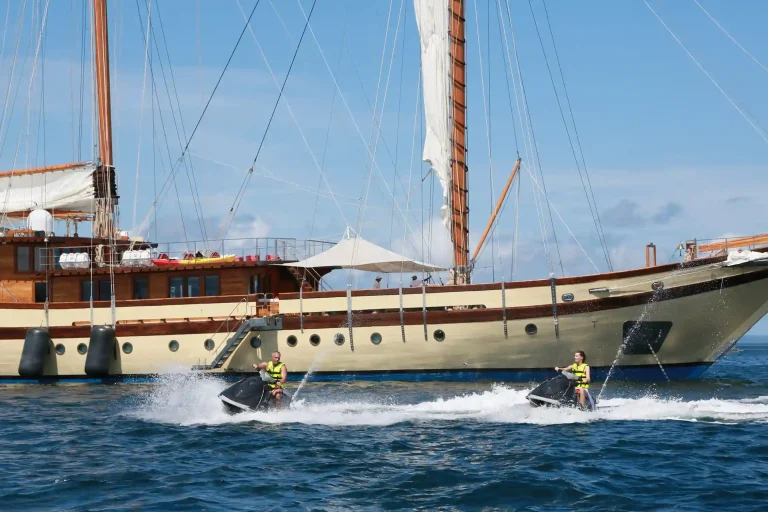
What is usually extra: alcohol (almost always separate, bring your own or purchase onboard), full scuba equipment rental and dive guides (even when the boat carries tanks and a compressor), nitrox, park entrance fees at budget and mid-range tier, and optional add-ons like a private beach dinner, a photography session, or water toys beyond the standard SUP and kayak. At the luxury and flagship tier, park fees and beverages are increasingly bundled — confirm the specific inclusions line by line in your charter brief.
The 3-Cabin Boat for Six Guests: A Practical Note
A boat for six people on a Labuan Bajo charter most naturally fits a three-cabin mid-range phinisi — one cabin per couple, each with its own AC and, on newer builds, an ensuite bathroom. This is the standard configuration for the sewa kapal labuan bajo 4d3n market: a boat designed for six to eight guests, three to four cabins, a crew of six to ten, and a dedicated cook. At this size you get the space to spread out, a proper dining table under the awning, and a sundeck with enough room that the group is not on top of each other.
If your group is larger — eight to twelve guests — move to a five or six-cabin vessel. If it is just two, a three-cabin boat is still the minimum worth booking for a south-Komodo itinerary; the smaller two-cabin boats have their speed and intimacy, but the berth and deck space become limiting on a four-day passage. Honeymoon bookings on a 3-cabin phinisi are common and practical: you occupy the master cabin, the remaining cabins serve as storage and crew quarters for the photography add-on, or stay empty.
Planning and Booking Your 4-Day Komodo Charter
The itinerary on this page is a framework, not a fixed product. The actual day-by-day is built around your group — whether you dive or snorkel, whether the kids need afternoon rest time, whether you want a second dive at Cannibal Rock or would rather spend that time on the beach at Horseshoe Bay. The komodo sailing 4d3n slow itinerary exists as a genuine option: some groups find the four days most satisfying when they eliminate one dive site and add two hours of doing nothing in a bay no other boat is using.
Our concierge team — the Indonesia Juara planning team, a sister brand within Juara Holding Group — builds the brief with you before matching to vessels and operators. They work across vessel classes from mid-range phinisi to flagship luxury, and their help costs you nothing. If you proceed with a partner through the recommendation, the operator may pay us a referral fee at no extra cost to you; no one can pay to change what we publish or recommend.
To start: fill in our charter brief form or reach the team directly on WhatsApp — response time is typically same-day during business hours. Bring your travel dates, group size, approximate budget per night, and whether you need the October–April south-Komodo version or the May–September north circuit.
Frequently Asked Questions
How much does a 4D3N Komodo boat charter cost?
Three nights on a private charter departing Labuan Bajo into Komodo National Park runs roughly USD 9,000–90,000 depending on vessel class, season, and group size — implied from 3 nights × the $3,000–$30,000/night range across mid-range to flagship luxury phinisi and yachts (last verified June 2026). A worked example: a mid-range 3-cabin phinisi at an implied $4,000/night totals $12,000 before park fees. Budget wooden boats sit below this range at around $1,200–2,500/night implied. Peak season (July–August, Christmas/New Year) adds surcharges; shorter charters typically cost more per night than longer ones on the same boat.
Can I reach Cannibal Rock and Manta Alley on a 4-day itinerary?
Yes — but only on the October–April version, and Manta Alley is an attempt rather than a guarantee. Cannibal Rock in Horseshoe Bay is the anchor dive site of Day 2 (Oct–Apr), and the Day 3 morning visit to Yellow Wall can include a second pass. The sail to Manta Alley from Horseshoe Bay takes about three hours each way; the captain makes the go/no-go call on current and swell conditions that morning. Karang Makassar (Manta Point) on Day 4 is accessible and reliable year-round regardless of season.
Is a 4D3N charter the right length for non-divers?
It works well, particularly on the May–September north circuit or for families. The dragon treks at Rinca and Komodo Island, the Padar sunrise, Pink Beach, Taka Makassar sandbar, and the Kalong bat flight are all non-dive experiences, and they fill the itinerary without needing a single tank. Snorkelling is available at most sites where divers enter the water. If your group mixes divers and non-divers, a mid-range phinisi with enough deck space for the snorkellers to do something else while divers are down is worth specifying in your brief.
What is the difference between the Oct–Apr and May–Sep versions of this trip?
The south Komodo sites — Horseshoe Bay, Cannibal Rock, Yellow Wall, and Manta Alley — are accessible when the northwest monsoon calms the southern approaches (roughly October to April). The southeast trades that build from May onward create swell conditions that make the south coast uncomfortable to impossible. The May–September version substitutes the south swing with the northern dive circuit: Crystal Rock, Castle Rock, and Gili Lawa Darat. Both versions include Padar sunrise, at least one dragon island, Karang Makassar mantas, and Taka Makassar. The north version has arguably better vis on the dive sites and calmer Gili Lawa anchorages; the south version has Cannibal Rock and the manta-alley attempt. Book the season that matches your priority.
How far in advance should I book a 4-day private phinisi charter from Labuan Bajo?
For a specific vessel in peak season (July–August or Christmas/New Year), three to six months ahead is realistic for mid-range to luxury phinisi. Shoulder months (October–November, April–May) can sometimes be booked six to eight weeks out. Budget wooden boats have more availability at shorter notice. Komodo National Park’s SiORA advance-booking system and the reported daily visitor cap mean that even if a boat is available, park entry slots can be the bottleneck — your operator handles this, but it reinforces the case for booking early rather than late.