Liveaboard Charter Labuan Bajo — Take the Whole Boat, Sleep Inside Komodo National Park
Liveaboard charter Labuan Bajo: take the whole boat into Komodo National Park. Per-night rates USD 3,000-30,000, day-by-day routes, concierge planning.
22 min read
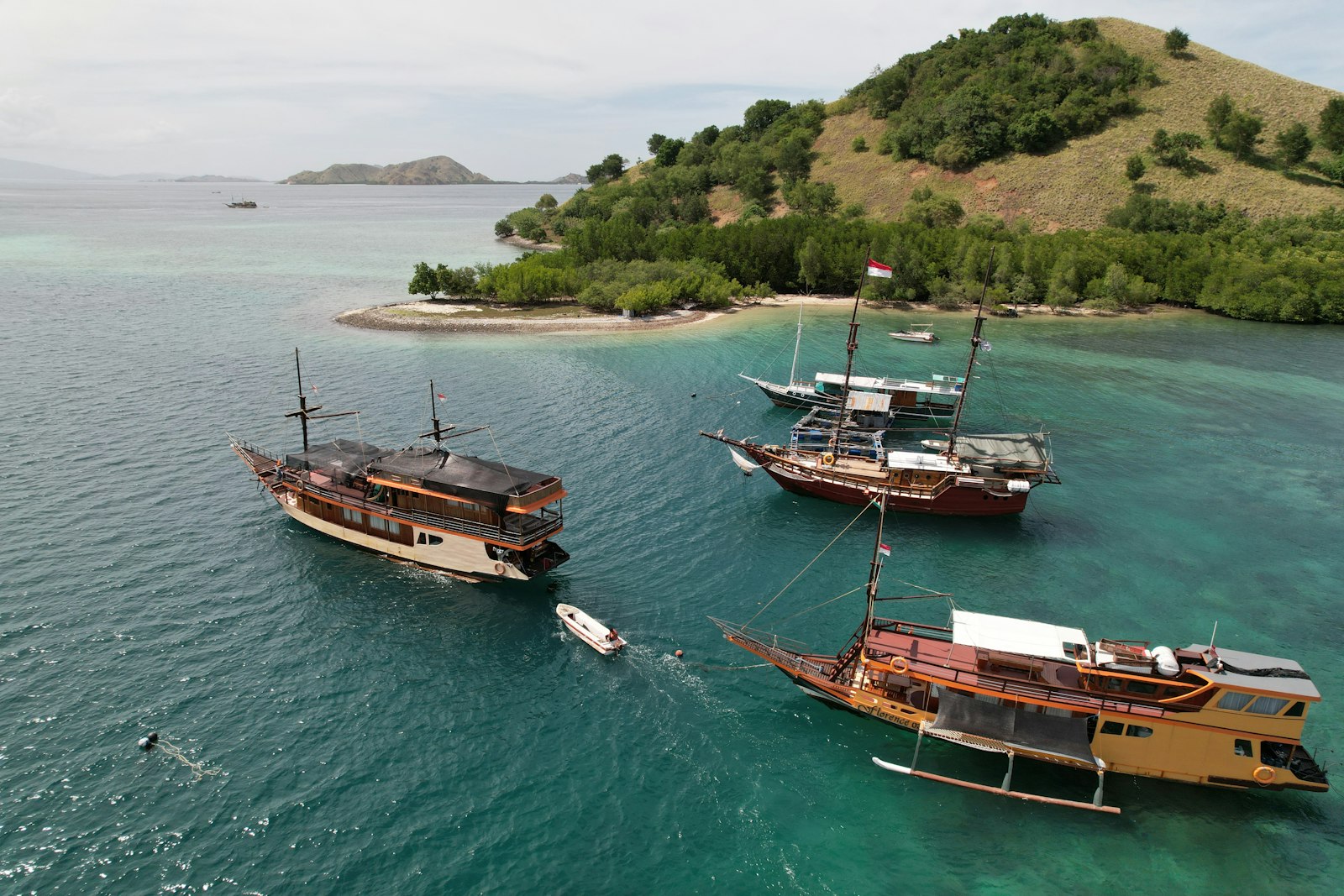
A liveaboard charter from Labuan Bajo means your group books the entire boat — every cabin, the full deck, the cook and crew — and sleeps at anchor inside Komodo National Park night after night, rather than sharing a vessel with strangers or racing back to a hotel. This is the format that lets you stand on Padar summit at first light before any day-boat appears, watch ten thousand flying foxes pour out of Kalong Island at dusk, and wake inside the park for eight days running if that is the charter you choose. Labuan Bajo and Komodo National Park are one destination in practice: the marina is the gateway, the Park is the backyard, and a private liveaboard is the only way to treat them as such.
Why Sleeping at Anchor Changes Everything
Day trips from Labuan Bajo reach Padar in three to four and a half hours each way. That burns most of the day just sailing. A liveaboard charter positions the boat at anchor an hour from Padar the night before, so you trek the ridge at 05:45 when the light is horizontal and the crater bays below are still mist-covered. The boat is already there. There is no morning dash from a Labuan Bajo hotel.
The same logic applies at Kalong Island. The sunset bat flight — hundreds of thousands of Pteropus vampyrus fruit bats streaming out across the pink sky — happens at a specific hour on specific tides. Day-boat guests see it then must sail back to Labuan Bajo in the dark. On a liveaboard charter you eat dinner at anchor fifty metres from the mangroves, then wake to silence and the sound of the current. Pink Beach at 07:00, before the first shared speedboat rounds the headland, is a different beach entirely.
Gili Lawa Darat is another example. The north-bay anchorage is quiet, the ridge hike at sunset is genuinely spectacular, and the tide-swept channels around Gili Lawa Laut hold some of the most current-charged reef in the central Komodo corridor. None of that is accessible on a day circuit. You need to be there overnight.
This is not an argument for liveaboard over resort. It is a statement of what the format unlocks, duration by duration, which no day trip can replicate.
What Liveaboard Nights Unlock: The Duration Ladder
2 Days 1 Night — The Essential Overnight
One night, one anchorage, the core triangle. Kelor Island in the morning for the hill walk and first snorkel. Rinca (Loh Buaya) in the afternoon for the ranger-guided Komodo dragon encounter — about a 90-minute to two-hour sail from Labuan Bajo, close enough to fit on a single day. Then the sail to Kalong for the dusk bat flight, dinner at anchor. The following dawn: a pre-dawn run to Padar for sunrise, then Pink Beach, Karang Makassar for mantas, and home to Labuan Bajo by late afternoon.
One Komodo dragon site only (Rinca, closest to Labuan Bajo). No south loop. No Gili Lawa. But the four images most guests come for — Padar sunrise, Pink Beach, dragons, bats — all fit. This duration suits travelers anchoring the charter inside a longer Flores or Bali trip. Not the right shape for divers wanting a real rotation.
Charter math: 1 night × USD 3,000–30,000 = USD 3,000–30,000 before park fees.
3 Days 2 Nights — The Signature Loop
Two nights, both major dragon sites, the north anchorage at Gili Lawa Darat. This is the shape most private liveaboard komodo charters take for first-timers and honeymooners. The structure:
Day 1: Depart Labuan Bajo 08:00–09:00. Kelor Island trek and snorkel. Afternoon option: Manjarite house reef or Rinca dragons (swap to fit preference). Kalong Island for the dusk bat flight; dinner at anchor.
Day 2: Pre-dawn sail to Padar for sunrise (roughly 1.5–2 hours from Kalong). Pink Beach swim and snorkel. Afternoon: Komodo Island, Loh Liang, ranger-guided dragon walk. Sail north about 1.5–2 hours to Gili Lawa Darat. Sunset ridge hike with views across the park. Anchor in the bay.
Day 3: Karang Makassar for manta ray drift at slack tide. Taka Makassar tidal sandbar (tide-dependent, not guaranteed). Tatawa Besar or Kanawa reef stop in the afternoon. Home run to Labuan Bajo by 16:00–17:00.
Best for: honeymooners, first-timers, anyone wanting the full postcard set — Padar, Pink Beach, dragons at both major sites, the Gili Lawa ridge, mantas — without repeating a site or rushing a leg. The manta odds at Karang Makassar are highest December through March when plankton concentrations peak, though mantas appear year-round at this location.
Charter math: 2 nights × USD 4,000/night = USD 8,000 (mid-range example). Full range: USD 6,000–60,000 before park fees.
4 Days 3 Nights — First Unlock: South Komodo (October–April)
Three nights open the south loop — Horseshoe Bay, Cannibal Rock, and the approach to Manta Alley. This is a seasonal product. The south coast of Komodo sits exposed to the southeast trades from May to September; swells can make Horseshoe Bay uncomfortable and Manta Alley inaccessible. October to April, under the northwest monsoon, south Komodo is calm and extraordinary.
The October–April structure adds a full south swing on Day 2: after Padar sunrise, the boat rounds the headland and heads south — about two to three hours — to Horseshoe Bay. Cannibal Rock here is one of the most color-dense dive and snorkel sites in Indonesia. Wild Komodo dragons walk the beach at Loh Dasami. The night at anchor in Horseshoe Bay has a quality the central anchorages lack: complete silence, a black volcanic shoreline, and the odd dragon silhouette at dusk.
For May–September charters, the Day 2 south leg is replaced by a north dive day: Batu Bolong, Crystal Rock, or Castle Rock depending on current. These are world-class current pinnacles; certified divers in the group rate this variant as highly as the south alternative.
Charter math: 3 nights × USD 5,000/night = USD 15,000 (mid-luxury example). Full range: USD 9,000–90,000 before park fees.
5 Days 4 Nights — The Full Figure-8
Four nights allow the complete north-plus-south figure-8 without backtracking — the shortest duration where a group genuinely covers the whole park in one pass. Both dragon sites, Padar sunrise, south loop with Manta Alley (October–April), north pinnacles at Castle and Crystal Rock, Gili Lawa sunset ridge. Twelve to sixteen dives is realistic for a group doing three to four per day.
This is the sweet spot for photographer groups and honeymoon charters that want every light condition — dawn Padar, the green-water canyon light at Cannibal Rock, Castle Rock at midday current peak, Gili Lawa in the last horizontal light. The itinerary visits each at the right time of day rather than whatever the schedule allows.
Charter math: 4 nights × USD 5,000/night = USD 20,000 (mid-luxury example). Full range: USD 12,000–120,000 before park fees.
6 Days 5 Nights — Figure-8 Plus Gili Banta
Five nights crosses the park’s northern boundary to Gili Banta — a volcanic island with frontier dive sites (K2 wall, GPS Point) where you will likely be the only boat at anchor. This is the first duration where returning guests diverge from first-timers: Banta is the site experienced Komodo visitors specifically ask for.
Charter math: 5 nights × USD 4,000/night = USD 20,000 (worked example for a mid-range komodo liveaboard full charter). Full range: USD 15,000–150,000 before park fees.
7 Days 6 Nights — Sangeang Volcano Unlock
Six nights is the first duration that honestly reaches Sangeang Api, an active stratovolcano off the Sumbawa coast. The crossing from Gili Banta takes three to four and a half hours; on approach you watch the smoke column against the sky. At anchor off Bontoh village, Bubble Reef sits in volcanic gas seeps rising through black sand — the most unusual dive site in the region. Techno Reef and Deep Purple are classic muck-diving sites, the antithesis of Komodo’s big-animal current diving and a genuine complement to the park’s biotopes.
The classic one-week private liveaboard labuan bajo charter lands here. Seven nights in the destination most divers list as a career ambition.
Charter math: 6 nights × USD 3,500/night = USD 21,000 (entry-tier example for a 7-night Komodo liveaboard private charter). Full range: USD 18,000–180,000 before park fees.
The Sangeang crossing is open water and calmest in the shoulder months of April–June and September–November. July and August are doable on most vessels but can be rolly. Check current PVMBG volcano advisories before departure — last verified June 2026.
Ready to design your itinerary? Our concierge team matches your group size, dates, and dive level to the right vessel class and builds the route around the season. Start with our charter brief form or reach us on WhatsApp — we typically respond within a few hours during Labuan Bajo business hours.
8–14 Days — The Grand Tour and Beyond
Eight nights completes the full park — both dragon islands, Padar, the entire south loop, all north pinnacles, Gili Banta, and Sangeang — the Grand Tour shape that serious divers plan for years. Twenty-four to twenty-eight dives across every Komodo biotope: south cold-water color at Cannibal Rock, central manta drifts at Karang Makassar, north current peaks at Castle and Crystal Rock, volcanic black-sand macro at Sangeang.
Ten nights opens the first one-way crossing west — past Sangeang to Satonda’s crater lake and Moyo Island’s waterfall treks on Sumbawa, ending in Lombok or Bali. This shape requires no repositioning surcharge when the fleet naturally migrates in April–May or October–November. Guests flying out of Lombok or Bali anyway get extraordinary value: the boat is the transfer, no domestic flight needed.
Fourteen nights — the full Flores-to-Bali expedition — covers roughly 430–470 nautical miles: a Flores coast prologue starting from Labuan Bajo, the complete park, Gili Banta, Sangeang, Satonda crater lake, Moyo waterfalls, Sumbawa coast, Lombok Strait, disembarkation at Amed or Benoa (Bali). Thirty-five to forty dives across five distinct marine regions. This is a sabbatical charter, not a holiday. The per-night math at entry tier: 13 nights × USD 3,000 = USD 39,000. At the top of the market: USD 390,000. Two very different boats, one experience set no resort can replicate.
| Duration | Nights | What it unlocks | Entry-tier example (USD 3k/night) | Mid-luxury example |
|---|---|---|---|---|
| 2D1N | 1 | Padar sunrise, Pink Beach, Rinca dragons, Kalong bats, Karang Makassar mantas | USD 3,000 | USD 5,000–8,000 |
| 3D2N | 2 | Both dragon sites (Rinca + Komodo), Gili Lawa Darat anchorage | USD 6,000 | USD 10,000–16,000 |
| 4D3N | 3 | South Komodo loop (Oct–Apr): Horseshoe Bay, Cannibal Rock; or north dive day (May–Sep) | USD 9,000 | USD 15,000–24,000 |
| 5D4N | 4 | Complete figure-8: full north + full south; 12–16 dives realistic | USD 12,000 | USD 20,000–32,000 |
| 6D5N | 5 | Gili Banta frontier sites (K2 wall, GPS Point) | USD 15,000 | USD 25,000–40,000 |
| 7D6N | 6 | Sangeang volcano (Bubble Reef, Techno Reef black-sand muck) | USD 18,000 | USD 30,000–48,000 |
| 10D9N | 9 | Sumbawa crossing: Satonda crater lake + Moyo waterfalls; one-way to Lombok/Bali | USD 27,000 | USD 45,000–72,000 |
| 14D13N | 13 | Full Flores–Komodo–Sumbawa–Lombok–Bali expedition (~430–470 nm) | USD 39,000 | USD 65,000–130,000 |
All per-night brackets are implied from package pricing; the Komodo market quotes per trip. Last verified June 2026. Park fees, fuel surcharges for repositioning legs, and VAT are typically quoted separately — confirm per charter agreement.
Vessel Classes for a Private Liveaboard
Budget Wooden Boat
Two to four cabins, four to ten guests, 15–22 metres, three to six crew. Fan-cooled cabins on older boats, partial AC on newer ones. Shared bathrooms are common at this tier. Full board (three meals, water, tea) is standard across all classes including this one. Rates imply roughly USD 1,200–2,500 per night for whole-boat hire. This tier suits guests who sleep lightly, travel in small groups, and prioritize budget over cabin finish.
Mid-Range Phinisi Liveaboard
Three to six cabins, six to fourteen guests, 22–35 metres, six to ten crew. AC is standard; newer builds are increasingly all-ensuite, older ones may have one or two shared bathrooms. A dedicated cook is standard. Snorkel gear and life jackets are included; scuba tanks and dive guides are typically an add-on even on boats with a compressor aboard. Rates implied at roughly USD 2,500–8,000 per night. This is the broadest and most popular tier for an exclusive komodo liveaboard charter — most of the phinisi liveaboard labuan bajo market sits here.
Luxury Phinisi Liveaboard
Five to nine cabins, eight to eighteen guests, 30–65 metres, ten to twenty-one crew (the largest vessels approach a near 2:1 crew-to-guest ratio). Full AC, all-ensuite standard. SUPs and kayaks are near-universal; seabob-style water toys appear at the top of this tier. Rates imply roughly USD 8,000–20,000+ per night, with flagship vessels reaching USD 30,000 per night for whole-boat bookings. Minimum booking at this tier is typically five to seven nights in peak season, with many owners preferring weekly blocks July–August and Christmas. Fuel for standard Labuan Bajo to Komodo loops is usually included; one-way repositioning legs (e.g., Labuan Bajo to Bali) carry a repositioning or fuel surcharge — confirm per quote.
Onboard Norms: What Is Included and What Is Not
What Is Almost Always Included
- Full board (3 meals + snacks + water/tea/coffee)
- Dedicated cook/chef and full crew
- Snorkel gear and life jackets
- Fuel for standard Labuan Bajo–Komodo National Park loops
- Tender or dinghy for shore landings
What Is Usually Extra
- Alcohol — almost always extra, sometimes partially included on luxury charters; confirm per vessel
- Scuba diving — tanks and compressor may be aboard, but dive guides, nitrox, and full kit hire typically carry a separate daily rate even on well-equipped boats
- Komodo National Park entrance and ranger fees — on mid-range and budget charters, park fees are usually excluded and billed at actuals; on higher-end charters they are increasingly bundled as all-inclusive. Confirm per quote. As a rough guide (travel-site consensus, not official decree, verify at booking, last verified June 2026): foreign visitor entrance approximately IDR 250,000 per person per day; ranger guide approximately IDR 200,000 per group of up to five for Komodo and Rinca treks; Padar trekking approximately IDR 150,000 per group; diving surcharge approximately IDR 25,000 per diver per day. Park fees for a couple on a 3D2N charter could add roughly IDR 1,500,000–2,000,000 (approximately USD 90–125 at current exchange) before guide fees.
- Repositioning surcharges — one-way Bali-to-Labuan Bajo or reverse involves fuel, crew time, and port fees beyond the standard loop; quoted separately
- Drone permits — if you fly a drone inside the park, the permit is approximately IDR 2,000,000 per unit per day (last verified June 2026; verify at booking)
- VAT — Indonesian charter contracts may add 11–12% VAT; confirm the quote basis (net or gross)
Park reservations are made through the SiORA system (Sistem Informasi Online Reservasi Wisata Alam) — walk-in tickets were discontinued; advance booking is mandatory. A reported visitor cap of around 1,000 per day applies (single-source figure, June 2026). Your charter concierge handles park permit coordination, but confirm the timing lead during peak season.
Candid Boat-Life Expectations
AC and Cabins
Mid-range and luxury phinisi have AC in every cabin. Budget-tier boats often have AC in the saloon but fan-only cabins, or a single AC unit per two-cabin block. If ensuite bathrooms are non-negotiable — for a honeymoon, for example — stipulate it explicitly when inquiring. Not all boats at the lower end guarantee it. Luxury-tier boats are all-ensuite as standard.
Sea State in July–August
July and August are peak season — also the windiest. The southeast trades push a swell through the central Komodo corridor. Padar and Gili Lawa are exposed; nights at anchor can be rolly. Daytime crossings from Labuan Bajo to the park run into wind chop. This does not stop the charter; it means guests who are prone to seasickness should discuss vessel stability and motion-sickness management with the concierge before booking those months. The north dive sites (Castle Rock, Crystal Rock, Batu Bolong) are at their current-driven best in the dry season, which partly compensates for the swell.
South Komodo — Horseshoe Bay, Cannibal Rock, Manta Alley — is genuinely a different product October–April. Do not book the south sites in July–August expecting the same experience; sell the north alternatives honestly in those months.
Mantas: Two Different Sites, Two Different Seasons
Karang Makassar (Manta Point) in the central park is good year-round, with higher hit-rates in the plankton-rich months from December to March. Manta Alley in the south peaks in the wet season (roughly November–April is the marketed window), driven by upwelling on the south coast. These are not interchangeable: if the south-season mantas are the reason for your trip, book October–April. If year-round reliability matters more, Karang Makassar delivers that.
Night-Sailing and Harbor Permits
A night-sailing restriction applies to tourist boats after a series of incidents; overnight passages between anchorages inside the park are generally not permitted for charter vessels after a specific cut-off hour. All legitimate labuan bajo liveaboard boat hire operators hold the requisite sailing permits (SPB); your concierge confirms permit status as part of the vessel vetting process. The harbor authority (KSOP Class III Labuan Bajo) can suspend sailing permits during extreme-weather warnings — documented closures have occurred during BMKG advisories. This is rare and handled by operators, not guests, but is worth knowing if you are planning around a fixed flight departure.
Season Notes by Itinerary Shape
The following is a practical guide, not a guarantee. Weather is weather.
- April–October/November (dry season): calm seas on the north and central route; Jul–Aug trades add chop. Best visibility across the north and central corridor. South Komodo is rough May–September — route accordingly.
- October–April (northwest monsoon): the south opens. Horseshoe Bay and Manta Alley are accessible and productive. Jan–Feb is the wettest period — anchorages inside the park remain mostly protected but open-water crossings (Sangeang, Sumbawa) can be delayed.
- Shoulder months (April–May, October–November): the best all-round windows. Crossings to Sangeang, Satonda, and Moyo are calmest; fleet repositioning in these months can mean reposition pricing advantages for one-way charters to Lombok or Bali.
- Year-round operations: the 3D2N signature loop runs every month; even in wet season the central park anchorages are generally protected. Flexibility in the schedule — an extra night of buffer — absorbs the occasional weather hold.
Design your charter with our concierge team — we match the season, the route, and the vessel class to your dates. WhatsApp planning is available for quick questions before you commit to a full brief.
Park Fees, Permits, and the SiORA Booking System
Since the ticketing reform, Komodo National Park entrance is booked in advance through the SiORA online reservation system; walk-in tickets are no longer available. For a private liveaboard charter your operator coordinates this — you should not be arriving without confirmed park permits in peak season.
The fee structure (travel-site consensus, not official KLHK decree — verify at booking, last verified June 2026):
- Foreign visitor entrance: approximately IDR 250,000 per person per day
- Ranger/guide for Komodo and Rinca treks: approximately IDR 200,000 per group of up to five persons
- Padar trekking: approximately IDR 150,000 per group
- Diving surcharge: approximately IDR 25,000 per diver per day
- Harbour fee: approximately IDR 25,000 per person
- Drone: approximately IDR 2,000,000 per unit per day
There is no verified per-vessel park entry fee published in 2026 sources; vessel permits are handled at the operator level. The IDR 3.75 million conservation fee proposal from 2022 was scrapped and is not in force in 2026.
Funding Transparency
This site is a charter specialist, not an operator. The advice and itinerary frameworks here reflect what I have observed across years of matching groups to vessels in the Labuan Bajo market. No one can pay to change what we publish. If you use our concierge help and proceed with a charter operator, they may pay us a referral fee at no extra cost to you — that is how the concierge service remains free for charter guests.
Frequently Asked Questions
What does a full private liveaboard charter from Labuan Bajo cost per night?
The whole-boat range for a private liveaboard from Labuan Bajo into Komodo National Park runs roughly USD 3,000–30,000 per night depending on vessel size, cabin count, and crew-to-guest ratio. A mid-range phinisi liveaboard typically falls in the USD 3,000–8,000 range; luxury phinisi run USD 8,000–20,000 or more; the largest flagships are price on application and can reach USD 30,000 per night or above. All figures are implied from package pricing — the market quotes per trip — and are last verified June 2026. Peak-season surcharges (July–August, Christmas–New Year) apply, and park fees are usually quoted separately.
How many nights do I need to see Manta Alley and Horseshoe Bay in south Komodo?
South Komodo is a seasonal product. Horseshoe Bay, Cannibal Rock, and Manta Alley are accessible and calm under the northwest monsoon from roughly October to April; the southeast trades from May to September make the south coast rough and often inaccessible. If those sites are the goal, you need at least four days and three nights (4D3N) on an October–April charter — that is the minimum shape where the south swing fits without cutting the rest of the itinerary short. Five nights gives you both a full south loop and the north pinnacles at Gili Lawa without rushing any of it.
Is a private liveaboard charter better value than booking individual cabins on a shared cruise?
For groups of six or more, the per-person math is often comparable or better on a private phinisi liveaboard — and the experience is fundamentally different. You set the route, the mealtimes, the pace, and the dive schedule. For couples, private costs three to five times more per person than a shared cabin on a scheduled liveaboard, in exchange for complete privacy, a dedicated chef, and a fully flexible itinerary. Whether that tradeoff is right depends on the group and the budget — for a honeymoon or a significant-birthday charter, most guests who have done both say they would not go back to shared.
What is included in a standard liveaboard charter and what costs extra?
Full board — three meals, snacks, water, tea, and coffee, prepared by a dedicated cook or chef — is standard across all vessel tiers. Snorkel gear and life jackets are included. Alcohol is almost always extra. Scuba diving (guide, tanks, kit hire) is typically a daily add-on even on boats with a compressor. Komodo National Park entrance fees, ranger guide fees, and the Padar trekking fee are usually excluded on mid-range and budget charters and billed at actuals; some luxury all-inclusive charters bundle them. Drone permits, VAT, and repositioning fuel for one-way Bali legs are quoted separately. Always confirm the quote basis in writing before signing.
Can a private liveaboard run from Labuan Bajo year-round, or are there months to avoid?
The north and central Komodo route — Kelor, Rinca, Padar, Pink Beach, Karang Makassar, Gili Lawa — runs year-round. July and August bring the southeast trades; expect wind chop and livelier nights at anchor, but the charter operates. The south Komodo route (Horseshoe Bay, Manta Alley) is an October–April product; book it in those months and it is exceptional, book it in July–August and you will be disappointed. January–February is the wettest period, but most central park anchorages remain protected. Sangeang volcano crossings are calmest April–June and September–November. The short answer: no month is genuinely closed to the north-central route, but the itinerary shape should match the season — that is what the concierge planning process is for.