How Far Is Komodo from Labuan Bajo by Boat? Distances, Times & the North-vs-South Route Ladder
Leg-by-leg boat times from Labuan Bajo into Komodo National Park, north-vs-south route ladder, and season rules for rough seas. Last verified June 2026.
21 min read
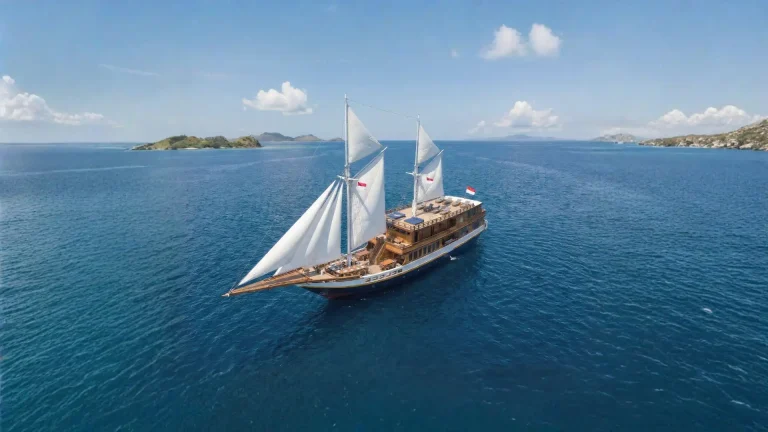
Guests asking how far is Komodo from Labuan Bajo by boat get a different answer depending on which island they are heading for. Komodo National Park spans roughly 20 to 70 kilometres east and southeast of Labuan Bajo — and on a private phinisi or yacht charter, that translates to anywhere from 45 minutes to a full 5-hour sail for the park’s outermost sites. For most guests, Labuan Bajo and Komodo National Park are a single destination experienced in one continuous voyage: you board in the harbour, the boat takes you there and back, and the cruising time between sites shapes how much you can fit into each day. Understanding those distances, and the logic behind which route fits which trip length, is the single most useful thing you can know before you start planning.
The Key Legs: Actual Cruising Times by Departure Point
All times below assume a phinisi or motor yacht cruising at 7–10 knots — the standard range for the boats you will actually charter in this region. Faster motor yachts running 12–15 knots compress every leg by roughly 30–40 percent. These are underway-only times: add 20–30 percent to account for sea state, current, and the inevitable slow-down when someone spots a pod of dolphins and everyone wants five more minutes. All figures last verified June 2026 — they are the best available benchmark, not a guarantee of any individual sailing day.
| Route Leg | Phinisi / Motor Yacht (7–10 kn) | Notes |
|---|---|---|
| Labuan Bajo → Kelor Island | 45–90 min | First stop on almost every charter; short viewpoint trek and snorkel |
| Labuan Bajo → Rinca (Loh Buaya) | 1.5–2.5 h | Main dragon-viewing station closest to LBJ |
| Labuan Bajo → Padar Island | 3–4.5 h | Sunrise trek; the boat typically sails overnight or departs pre-dawn |
| Labuan Bajo → Komodo Island (Loh Liang) / Pink Beach | 4–5 h | The park’s centrepiece; usually reached on Day 2 of a 3D2N charter |
| Pink Beach → Karang Makassar (Manta Point) | 30–45 min | Short hop; current-dependent snorkel or dive |
| Central park → Gili Lawa Darat / Laut | 1.5–2 h | Northern anchor; Labuan Bajo direct approx. 4.5–6 h |
| Gili Lawa → Gili Banta | 1.5–2.5 h | Just outside the formal park boundary; frontier diving |
| Padar → Horseshoe Bay (Loh Sera / south Komodo) | 2–3 h | Seasonal (Oct–Apr); the start of the south loop |
| Horseshoe Bay → Manta Alley | approx. 3 h | South-coast mantas; best Nov–Apr |
| Manta Alley → Loh Liang (Komodo Island) | 3–4 h | Return leg closing the south loop |
A few things jump out of that table. First, Kelor is close — close enough to visit before breakfast and still have a full afternoon ahead of you. Rinca is the right call when trip time is tight and you want dragons without a long overnight sail. Padar, though, requires commitment: you need to either sail through the night or push hard on Day 1 to anchor nearby and wake up for a pre-dawn start. That is exactly what guides every decision in route planning — the unlocks compound as nights accumulate.
The 20–30% Sea-State Padding Rule
The Flores Sea and the waters inside Komodo National Park are not open ocean, but they are not a sheltered bay either. In the dry season (roughly April through October) the southeast trades bring consistent wind from the south, which means the legs running north-south — Padar to Horseshoe Bay, for instance, or the crossing from the central park to Gili Lawa — can run against a chop. Tidal currents through the narrower passages add another variable: Lintah Strait and the channel between Rinca and the main islands can run at 3–5 knots even in calm conditions.
The practical rule is simple: take any quoted cruising time, add 20–30 percent, and that is your planning figure for a normal day. On a lumpy July morning with the trades up, the Padar sunrise leg might take 5 hours rather than 3.5. On a glassy November dawn with no current, you might bank 30 minutes. Experienced captains build these buffers automatically. When you discuss your charter brief with the Indonesia Juara concierge team, they will flag any legs that are particularly current- or swell-sensitive for your intended dates — it is one of the things that separates a properly designed itinerary from a trip that looks reasonable on paper but leaves everyone exhausted at anchor.
North vs South: The Route Ladder by Trip Length
This is the piece that most guides leave out, and it matters more than any individual leg time. Komodo National Park has three geographical zones — central, north, and south — and they do not become accessible simultaneously as you add nights. They unlock in a specific sequence, driven by sailing time and the seasonal viability of the south coast.
The Central Core (2 Nights): Kelor, Rinca, Padar, Pink Beach, Manta Point
A 2-night charter out of Labuan Bajo into Komodo National Park covers what I think of as the essential triangle. Day 1 takes you through Kelor’s viewpoint and first snorkel, then across to Rinca for the ranger-guided dragon walk, finishing at Kalong Island for the famous dusk flight of flying foxes. Day 2 is the pre-dawn sail to Padar, a 45-minute trek to the ridge at sunrise, then Pink Beach for a swim, and finally a drift at Karang Makassar for mantas before the 2.5–3.5-hour return to Labuan Bajo.
This circuit works because the legs are tight. Nothing in that sequence requires sailing more than 3.5 hours in a stretch, and the anchor spots for the one overnight are sheltered. It is a genuinely complete introduction — not a compromise version of something bigger, but a coherent product in its own right. The charter math: 1 night x USD 3,000–30,000 depending on vessel class (last verified June 2026).
What the 2-night charter cannot do: it leaves no time for Komodo Island’s Loh Liang (you choose either Rinca or Komodo, not both), and it puts Gili Lawa entirely out of reach. If those matter, you need to step up.
Adding the North: 3–4 Nights
The 3D2N charter is what most guests think of when they picture a Komodo sailing trip from Labuan Bajo, and the extra night earns its keep. The north opens up: Gili Lawa Darat becomes a second anchorage, the ridge hike at sunset is one of the best things you can do in this park, and the addition of Castle Rock or Crystal Rock gives divers a current-swept pinnacle dive that the central sites cannot match.
Crucially, the 3-night structure allows both dragon islands. The route typically runs: Kelor → Rinca (dragons) → Kalong (bats, overnight) → Padar sunrise → Pink Beach → Komodo Loh Liang (dragons) → north to Gili Lawa (overnight) → Karang Makassar mantas and Taka Makassar sandbar → home. The rute sailing komodo terbaik 3d2n that gets searched most often is exactly this loop — central core plus northern anchorage. Charter math: 2 nights x USD 3,000–30,000 = USD 6,000–60,000.
The 4D3N charter keeps the same north structure and adds a swing day. In the right season, that swing day goes south.
Adding the South: 5 Nights and Beyond — and Why Horseshoe Bay Is an Oct–Apr Product
This is the most important seasonal distinction in Komodo route planning, and I want to be direct about it because a lot of itineraries gloss over it. The south coast of Komodo National Park — Horseshoe Bay (Loh Sera), Cannibal Rock, Manta Alley, Yellow Wall, the Padar south sites — is a seasonal product. It is exposed to the southeast trades. From June through September, especially July and August, the southern swell makes that coast uncomfortable at best and inaccessible at worst. A good captain will not take you there in those months, and a well-designed itinerary will not promise it.
From October through April, under the northwest monsoon, the south coast is calm. Horseshoe Bay becomes one of the most beautiful anchorages in the park — a half-bowl of limestone cliffs with wild Komodo dragons wandering the beach — and Manta Alley lives up to its name. The manta season detail matters here too: Karang Makassar in the central park has mantas essentially year-round, with higher encounter rates in the plankton-rich December–March period. Manta Alley in the south pairs access and manta activity roughly November through April. They are different sites serving different seasons.
The 5D4N charter is the shortest duration where the south loop genuinely changes the product rather than feeling rushed. The figure-8 route — north to Gili Lawa and south to Horseshoe Bay without doubling back — requires four nights to execute comfortably. That is why the unlock ladder reads: 2N central core → 3–4N adds the north → 5N+ adds the south, conditional on season.
For guests coming in July or August who want the equivalent of a 5-night product, the honest version swaps the south loop for additional north and central dives: Siaba Besar for turtles, Batu Bolong, Tatawa Kecil. These are excellent sites, just different ones. Charter math on a 5-night phinisi or yacht: 4 nights x USD 3,000–30,000 = USD 12,000–120,000.
What to See in Komodo National Park: The Must-See Highlights by Zone
Since route logic shapes what is reachable, it helps to know what sits where. Here is how the park’s headline sites map to each zone.
Central Zone (accessible on 2+ nights)
- Kelor Island
- 45–90-minute sail from Labuan Bajo. Short viewpoint trail with wide harbour views; good house reef for the first snorkel of the trip. Nearly always a Day 1 stop.
- Rinca Island — Loh Buaya
- Closest major dragon site, 1.5–2.5 hours from Labuan Bajo. Ranger-guided treks work best in the morning when dragons are active around the ranger station. Often preferred on shorter charters because it does not require a long overnight sail.
- Padar Island viewpoint
- The postcard image: three bays visible from the ridge at once. 3–4.5 hours from Labuan Bajo, so the sunrise position typically requires sailing overnight to anchor north of Padar, then a 45-minute trail at dawn. This is one of the must see places komodo islands has to offer, regardless of trip length.
- Pink Beach
- About 30–45 minutes from Padar, on the north coast of Komodo Island. The pink tint is real — red coral fragments in the sand. Good snorkelling off the beach. On the rute kapal labuan bajo pulau padar pink beach komodo, this is the natural second stop after the Padar ridge hike.
- Komodo Island — Loh Liang
- The park’s main ranger station and the only place for a guided dragon walk on Komodo Island itself. 4–5 hours from Labuan Bajo; typically reached via an overnight anchor at Kalong or Rinca. Cooler morning conditions keep the dragons active.
- Karang Makassar (Manta Point)
- Tidal cleaning station 30–45 minutes from Pink Beach. Mantas glide in from the channel to be cleaned; the drift snorkel or dive here is one of the best komodo highlights padar pink beach manta point experiences in the park. Year-round, though December–March tends to produce the most reliable encounters.
- Taka Makassar
- Tide-dependent white sandbar that appears at low water — not guaranteed; the timing must be planned around the tides. On the rute sailing komodo mampir manta point taka makassar, these two sites are usually combined into one morning.
Northern Zone (accessible on 3+ nights)
- Gili Lawa Darat and Gili Lawa Laut
- 1.5–2 hours north of the central park; the bay at Gili Lawa Darat is a protected anchorage, and the ridge hike at sunset rivals Padar for views. Gili Lawa Laut has a calm lagoon good for swimming and snorkelling.
- Castle Rock and Crystal Rock
- Advanced dive sites in the channel between Gili Lawa and Gili Banta. The current here runs hard; these are peak komodo highlights for experienced divers, and they earn their reputation.
- Kalong Island
- Not a dive site — this is the bat-flight island. At dusk, millions of flying foxes exit the mangroves in a continuous stream for 20–30 minutes. Almost every 3D2N charter anchors here on Night 1.
- Batu Bolong and Tatawa
- Coral-encrusted pinnacles in the northern park; both work as dive or snorkel sites and are good dry-season alternatives when the south is not viable.
Southern Zone (Oct–Apr, accessible on 4+ nights)
- Horseshoe Bay (Loh Sera / Loh Dasami)
- 2–3 hours south of Padar. Sheltered horseshoe of cliffs; wild Komodo dragons on the beach reached by tender; calm enough to anchor comfortably under the northwest monsoon. Oct–Apr only.
- Cannibal Rock
- South Rinca dive site famous for nudibranchs, pygmy seahorses, and exceptional wall life. One of the most photogenic sites in the region.
- Manta Alley (Torpedo Bay)
- 3 hours from Horseshoe Bay. Peak season November–April when plankton concentrations are highest. Not the same as Karang Makassar — this is a different site serving the south-coast season.
- Yellow Wall
- Soft-coral wall dive at the southern end of Komodo; best in the early morning when the current is manageable.
Ready to map these sites into a specific duration? Design your charter with the Indonesia Juara concierge team — they will tell you exactly which sites are realistic for your dates and group size, and they will reach you by WhatsApp at whatever hour fits your timezone.
Season Notes: Best Time to Avoid Rough Seas in Komodo
No season is uniformly calm across the whole park, and no season is uniformly rough. The split is directional and site-specific, which is why blanket advice about going in dry season can mislead.
April through October (dry season): The southeast trades bring clear skies and strong visibility for snorkelling and diving in the central and northern park. Gili Lawa, Castle Rock, Batu Bolong — these sites are at their best. The south coast is exposed to the same trades and is inaccessible or uncomfortable for most of this period. July and August are the busiest months; the park can feel congested at the popular sunrise spot on Padar, and the Gili Lawa anchorage is breezier than it looks in photographs.
November through March (wet season, with northwest monsoon): Rain is real — January and February have the heaviest squalls, and some days bring genuine rough weather across the whole park. The KSOP harbour authority in Labuan Bajo has suspended sailing permits during periods of extreme weather (documented closures include March 2024 and a period in late 2025–early 2026). The upside: the south coast is calm under the northwest monsoon, Manta Alley and Horseshoe Bay are accessible, and the manta encounter rates at Karang Makassar are at their yearly peak. December and March are broadly the most reliable wet-season months; mid-January through February is the riskiest window, though rarely does bad weather cost more than a day of activity when the itinerary has been designed with flexibility.
The practical summary: if your priority is the south loop — Manta Alley, Horseshoe Bay, Cannibal Rock — plan for October through April. If your priority is diving the northern pinnacles in flat conditions, April through June and September through November are the shoulder-season sweet spots. July and August work well for the central and north route; just do not book Horseshoe Bay and be honest with yourself about the Padar anchorage being a little bouncy at night. This is the best time to avoid rough seas in komodo logic: route and season must be chosen together, not independently.
The Route Ladder: Which Duration Fits Which Route
Here is the unlock logic as a single reference. The prices shown are implied per-night ranges from the 2026 market (last verified June 2026); the market quotes per trip, not nightly, so these are derived figures to help you budget.
| Duration | Route Zones Accessible | What You Cannot Do | Budget Range (whole boat) |
|---|---|---|---|
| 2D1N (1 night) | Central core: Kelor, Rinca or Komodo (not both), Padar, Pink Beach, Manta Point | Both dragon islands; Gili Lawa; south loop | USD 3,000–30,000 (1 night) |
| 3D2N (2 nights) | Central plus north: both dragon islands, Padar, Pink Beach, Gili Lawa sunset, Taka Makassar | South coast; extended dive rotation | USD 6,000–60,000 (2 nights) |
| 4D3N (3 nights) | Central plus north plus south swing day (Oct–Apr); or north dive day (May–Sep) | Full south loop; Gili Banta | USD 9,000–90,000 (3 nights) |
| 5D4N (4 nights) | Complete figure-8: full north and full south (Oct–Apr); 12–16 dives realistic | Gili Banta; Sangeang | USD 12,000–120,000 (4 nights) |
| 6D5N (5 nights) | Figure-8 plus Gili Banta; empty anchorages; 16–20 dives | Sangeang volcano | USD 15,000–150,000 (5 nights) |
| 7D6N (6 nights) | Full park plus Gili Banta plus Sangeang volcano; 20–24 dives | Moyo–Satonda (too far) | USD 18,000–180,000 (6 nights) |
| 8D7N (7 nights) | Grand Tour: everything in the park plus Sangeang plus Banta; 24–28 dives across all biotopes. Example: 7 nights x USD 4,000/night = USD 28,000 on a mid-range phinisi. | Moyo and Lombok | USD 21,000–210,000 (7 nights) |
| 10D9N and above | Full crossing: Komodo plus Sangeang plus Satonda crater lake plus Moyo waterfalls plus Lombok and Bali one-way | Nothing — this is the complete product | USD 27,000–270,000+ (9 nights) |
A note on that budget table: the per-night range of USD 3,000–30,000 reflects vessel class, not duration. A 3-night honeymoon on a mid-range phinisi runs roughly 2 nights x USD 4,000 = USD 8,000 before park fees, fuel, and gratuity. The same 3 nights on a luxury vessel in the USD 15,000-per-night bracket would be USD 30,000. The class you choose should match the group size and the experience you want — not just the number that fits a rough budget. That is exactly the conversation the concierge team is built for.
A Closer Look at the 3D2N Rute Sailing Komodo
Because so many guests arrive asking specifically about the rute sailing komodo terbaik 3d2n, it is worth spelling out the logic of this itinerary in detail. The 3-day, 2-night sailing charter from Labuan Bajo is, genuinely, the most complete introduction to Komodo National Park that you can do without extending to a week.
Day 1: Depart Labuan Bajo 08:00–09:00. The first stop is Kelor Island — about an hour out — for a short viewpoint trail and an introductory snorkel. The afternoon goes to Rinca’s Loh Buaya for the ranger-guided dragon walk, which works better in the cooler late-afternoon light when the dragons are still mobile. From Rinca, the boat sails to Kalong Island for the dusk flying-fox exodus — the first sunset at anchor, dinner on deck, and a night in the calm bay.
Day 2: Pre-dawn departure (typically 04:00–05:00) from Kalong toward Padar, arriving in time to start the ridge hike in the dark and reach the summit at first light. Then south to Pink Beach for an unhurried swim and snorkel, and across to Komodo Island’s Loh Liang for the afternoon dragon trek — which covers the species’ home island and feels noticeably different from Rinca in scale and atmosphere. The boat sails north in the afternoon to anchor at Gili Lawa Darat, arriving in time for the sunset hike to the ridge above the bay.
Day 3: The morning goes to Karang Makassar for the manta drift at slack tide, then to Taka Makassar if tides align for the white sandbar. An optional snorkel stop at Tatawa Besar or Kanawa, and then the 3–4-hour return to Labuan Bajo, arriving alongside around 16:00–17:00.
That sequence covers six distinct experiences — dramatic viewpoint, two dragon treks, bat flight, beach swim, manta drift, sunset ridge — across three consecutive days with no backtracking. It is the backbone route from which every longer itinerary is extended, not a compressed version of something better. Charter math: 2 nights x USD 3,000–30,000 = USD 6,000–60,000 whole boat depending on vessel class.
Practical Planning Notes
A few logistics that affect how route times translate into real experiences:
Park entry and ranger fees: Komodo National Park uses the SiORA advance booking system (Sistem Informasi Online Reservasi Wisata Alam) — walk-in tickets have been discontinued. Foreign visitor entrance fees run IDR 250,000 per person per day; ranger fees for guided treks add IDR 150,000–200,000 per group depending on the site. These are travel-source figures as of June 2026 — verify at booking as park fee structures have changed repeatedly in recent years. Most mid-range and luxury charter operators handle permit logistics; budget boats often quote fees separately.
Night sailing and the restriction on tourist boats: Following a shipwreck incident, Indonesian authorities implemented a night-sailing restriction for tourist boats in the national park. This means the pre-dawn sail to Padar — which is the standard approach for the sunrise trek — operates in a defined window, not arbitrarily at any hour. Your captain will know the current rules; it is worth confirming the departure time in your pre-trip call so the 4am wakeup is not a surprise.
LBJ airport connections: Labuan Bajo’s Komodo Airport (LBJ) has direct domestic services from Bali’s Ngurah Rai (DPS) multiple times daily and connections from Jakarta. No scheduled international service runs as of 2025–2026. Most guests fly Bali to Labuan Bajo and begin their charter the same afternoon or the following morning.
If you are working through a longer itinerary — particularly anything 7 nights or above — the Indonesia Juara concierge team can walk you through the full cost structure including park fees, fuel for longer legs, and seasonal timing. Start with our charter brief form or send a message via WhatsApp: the team responds across most timezones and can often sketch a route proposal within 24 hours. No one can pay us to change what we recommend; if you end up booking through an operator we suggest, they may pay us a referral fee at no extra cost to you.
Frequently Asked Questions
How long does it take to sail from Labuan Bajo to Komodo Island?
On a phinisi or motor yacht sailing at 7–10 knots, Komodo Island’s main ranger station at Loh Liang is approximately 4–5 hours from Labuan Bajo harbour. Most charters do not sail this leg in a single push from the start of the day — instead the boat departs in the morning, stops at Kelor Island and Rinca along the way, and arrives at the Komodo Island anchorage by mid-afternoon or the following morning. If you are on a faster motor yacht running 12–15 knots, the direct passage is closer to 2.5–3 hours. All times last verified June 2026.
What is the best time of year to avoid rough seas in Komodo National Park?
For the central and northern park — Padar, Pink Beach, Gili Lawa, Manta Point — the dry season from April through October is generally the calmest. July and August have the strongest southeast trades, which means breezier conditions and occasional chop, but diving visibility is excellent. For the south coast (Horseshoe Bay, Manta Alley, Cannibal Rock), October through April under the northwest monsoon is the viable window. January and February carry the highest risk of genuine bad-weather days across the whole park. If you are sailing from Labuan Bajo into Komodo National Park for the first time and weather predictability matters most, the shoulder months of April–June and September–November offer the most consistent conditions across both zones.
Can you reach Padar and Pink Beach in a single day trip from Labuan Bajo?
Technically possible on a fast speedboat, but it makes for a punishing and unsatisfying day. Padar alone is 3–4.5 hours each way on a phinisi, and the sunrise trek is the whole point — which means you would need to leave Labuan Bajo around midnight to be there for dawn. In practice, the rute kapal labuan bajo pulau padar pink beach komodo is designed as an overnight trip: the boat sails the afternoon or evening before, anchors near Padar, does the sunrise hike, then continues to Pink Beach before returning to Labuan Bajo. A 2-day, 1-night charter is the minimum that makes this combination worthwhile.
Do mantas appear year-round at Manta Point in Komodo?
Karang Makassar — the site most operators call Manta Point — has resident manta rays year-round. It is a cleaning station, and the mantas come in regardless of season. Encounter rates tend to be highest from December through March when plankton concentrations are elevated. Manta Alley on the south coast is a different site entirely: it is primarily a wet-season and early dry-season spot (roughly November through April), paired with the south route that only becomes viable once the northwest monsoon settles the southern anchorages. Never book a charter specifically around a manta guarantee — wildlife is wildlife — but Karang Makassar is about as reliable a manta site as exists anywhere in Indonesia.
How far in advance should I book a private charter from Labuan Bajo into Komodo National Park?
For peak months — July, August, and the Christmas and New Year window — the better vessels are often committed 6–12 months ahead, particularly the luxury phinisi tier running USD 10,000 per night and above. Mid-range boats (roughly USD 3,000–8,000 per night) can sometimes be confirmed with 4–8 weeks’ notice outside peak. Shoulder months are more flexible. The SiORA park entry booking system adds an additional lead-time consideration: permits for specific sites need to be booked in advance. Starting the conversation early gives the concierge team room to match both the right vessel and the right permit dates for your preferred itinerary.