Manta Season in Komodo: Karang Makassar vs Manta Alley from a Private Charter
Manta season in Komodo NP explained: Karang Makassar year-round, Manta Alley peaks Nov–Apr. Private charter timing, snorkel rules & site comparison.
18 min read
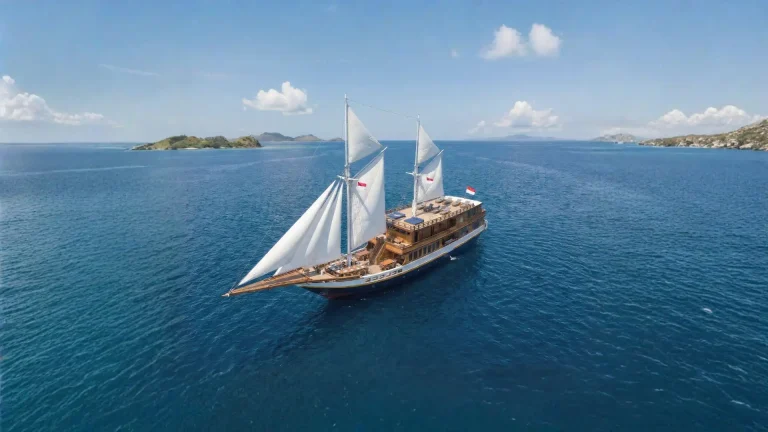
Manta season in Komodo National Park does not follow a single calendar. The park holds two distinct manta aggregation sites — Karang Makassar in the central zone and Manta Alley in the south — and each responds to a different seasonal driver. Karang Makassar, widely marketed as Manta Point, aggregates reef mantas throughout the year with higher encounter rates during the plankton-rich months of roughly December through March. Manta Alley sits inside a southern cul-de-sac accessible primarily from Labuan Bajo under the northwest monsoon, and its window runs approximately November through April, peaking December through February. Most trip-planning pages collapse this into one season. They shouldn’t. Understanding the difference is what allows a private charter out of Labuan Bajo to be timed and routed correctly.
The Two Sites Are Not Interchangeable
Guests often arrive with a single mental image: a manta station somewhere in Komodo National Park, reachable on any charter. The reality is more interesting.
Karang Makassar (Manta Point) — Central Zone, Year-Round
Karang Makassar sits in the central corridor, roughly 30 to 45 minutes by phinisi from Pink Beach. It is a cleaning station — a shallow seamount where resident reef mantas hover in the current while cleaner wrasses pick parasites from their gill rakers and wing surfaces. The encounter is consistently dependent on tidal flow, not strictly on month. When current is running at the right speed, mantas are present. When the water is dead flat at neap tide, they often are not.
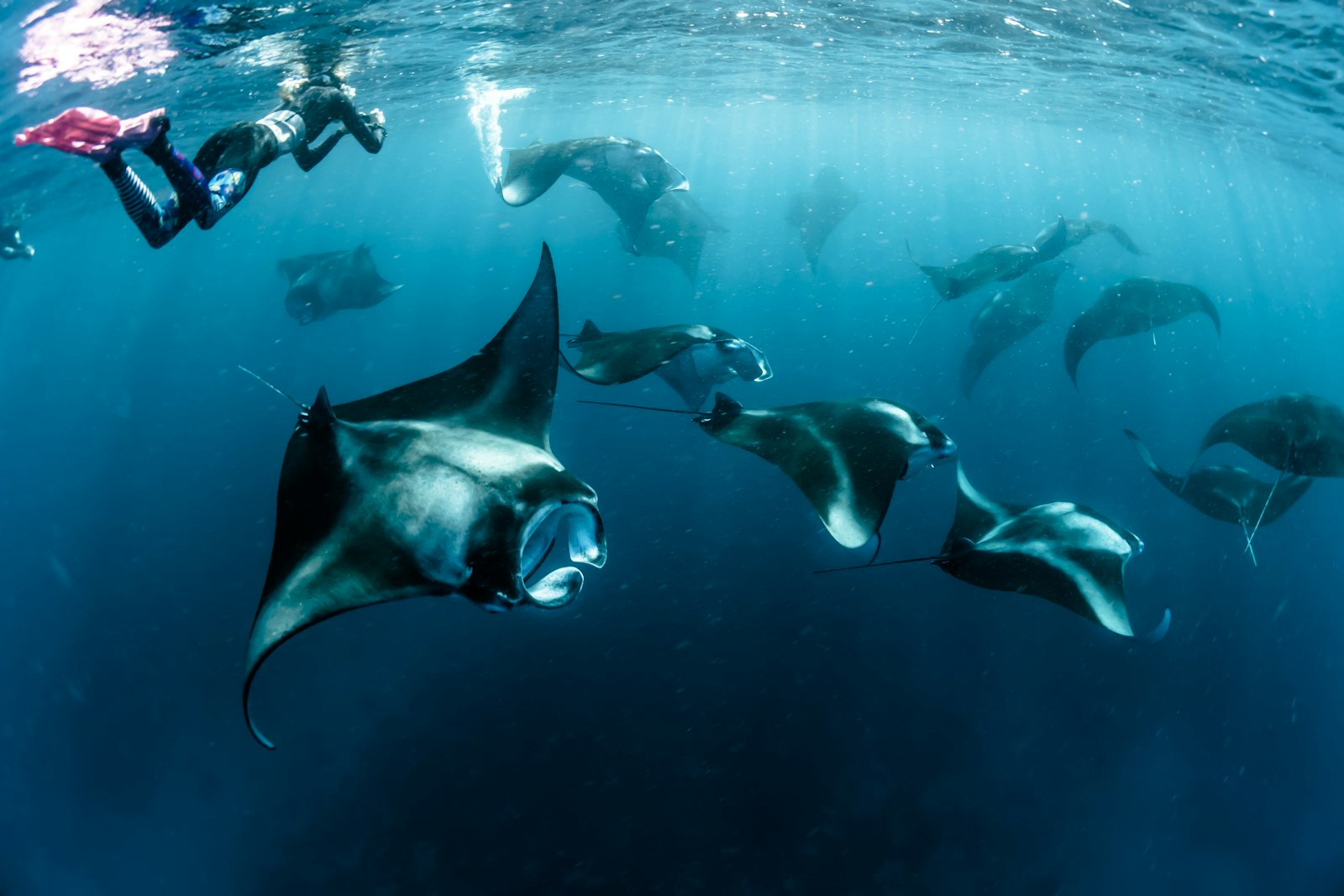
The key variable is plankton density. The December-to-March period sees higher nutrient upwelling in the central Komodo channel, which concentrates phytoplankton, which draws the mantas in with unusual regularity. This is when snorkelers and divers report groups of eight, twelve, sometimes more circling in slow choreography beneath the surface. In the dry season months of May through October, encounters are still common — operators and park guides consistently describe Karang Makassar as productive year-round — but you might find two or three individuals on a morning when December might have given you twelve.
No operator can guarantee mantas, at either site, in any month. That is the single most important sentence on this page.
Manta Alley — South Komodo, Seasonal Window
Manta Alley, sometimes called Torpedo Bay or listed under the broader Loh Sera south-coast anchorage area, is a different animal. Access is the first constraint. The south coast of Komodo Island sits exposed to the Sumba Strait, and during the southeast trade wind season — roughly May through September, worst in July and August — the swell arrives directly from the open Indian Ocean. Operators routinely defer or cancel south Komodo routing during this window. Not because mantas are absent, but because the anchorages are uncomfortable and the approach in any swell above two metres is inadvisable on a wooden phinisi.
Under the northwest monsoon (October through April), the south coast flips character. The mountains of Komodo Island shelter it from the northwest, and you arrive into flat, dark-blue water that feels entirely separate from the breezier north. The biomass here is different too: cooler upwelling from the south drives extraordinary reef fish density, which is why Cannibal Rock and Yellow Wall — both within the same south-coast routing as Manta Alley — consistently rank among the most species-rich reef dives in Indonesia. The manta aggregation at Manta Alley is part of this southern ecological system. The best month to see manta rays in the south specifically is probably January or February, but the honest range is November through April, with October and May as shoulder months where conditions are borderline and an experienced captain makes a go/no-go call.
| Factor | Karang Makassar (Manta Point) | Manta Alley (South Komodo) |
|---|---|---|
| Zone | Central Komodo NP | South Komodo Island |
| Travel time from Labuan Bajo (phinisi) | ~4–5 h to Pink Beach area, then 30–45 min to site | ~5–8 h depending on routing (via Horseshoe Bay) |
| Access season | Year-round | Oct–Apr practical window; Nov–Apr peak |
| Best encounter months | Dec–Mar (plankton peak); year-round viable | Nov–Apr; Dec–Feb highest biomass |
| Manta species typical | Reef manta (Mobula alfredi) | Reef manta; oceanic (Mobula birostris) possible |
| Dominant activity type | Cleaning station — surface hover, snorkel-accessible | Feeding aggregation in current — drift dive/snorkel |
| Current intensity | Moderate to strong on flooding tide | Strong; advanced-friendly, guide required |
| Minimum charter duration to include | 2D1N (Day 2 morning slot) | 4D3N minimum (Oct–Apr only) |
Can You See Mantas in Komodo in April?
April is one of the more interesting months to ask about. At Karang Makassar: yes, realistically any month of the year. The plankton peak is past its height but the water is often at its clearest — visibility can reach 25 metres or beyond as the wet-season particles settle out and the dry season hasn’t yet pushed everything north. April mantas at Karang Makassar tend to be smaller groups than January, but the sessions are often calmer and longer because current conditions stabilise.
At Manta Alley, April is a shoulder month. The northwest monsoon is retreating and the southeast trades haven’t yet established. A seasoned captain operating out of Labuan Bajo will check BMKG forecasts and make an honest call. In a typical year, south Komodo access is still workable in early April; by late April, the probability drops. A charter built around Manta Alley in April should not treat it as a certainty — route it as the priority south swing but carry a contingency north-day itinerary.
The short answer: April guests almost certainly see mantas at Karang Makassar. Manta Alley in April depends on the year. Budget for both options and let the concierge team track the forecast as departure approaches.
Drift-Snorkel Mechanics from a Private Boat
Here is where private charter out of Labuan Bajo creates a genuine structural advantage over shared trips or fast-boat day tours. The manta encounter at Karang Makassar is almost entirely governed by slack-tide timing. The mantas station themselves on the top of the seamount during the tidal flow. At peak flood or ebb, surface snorkelers get swept clear of the site within minutes, which is fine — a manta patrol at speed can be exhilarating — but the cleaning behaviour, where mantas hang nearly motionless and allow a prolonged face-to-face encounter at one to two metres of depth, happens in the thirty to forty-five minutes either side of slack water. That window is predictable. Tide tables are published by BMKG and Indonesian hydrographic charts months in advance.
On a private charter, your captain plans the overnight anchorage — typically near Pink Beach or the Komodo Loh Liang bay — to position the boat within a short run of Karang Makassar for the morning slack. Dawn departures of 05:30 or 06:00 from those anchorages drop the group over the seamount as the current begins to ease. You spend the productive window at the site. Then you move. Shared day-tour boats, departing Labuan Bajo harbour at 07:00 or later, often arrive at Karang Makassar mid-current and miss the cleaning session entirely, catching only the trailing edge of behaviour at best.
At Manta Alley in the south, the same logic applies at higher current intensity. The site involves a genuine drift through a channel with exposed oceanic water on one side. The tender drops snorkelers upcurrent and retrieves them downstream. A private boat means your crew is completely focused on that retrieve — no other guests, no shared attention. The guide swims with the group. This is the configuration the site was designed for.
Planning a trip around manta timing? Design your charter with our concierge team and we’ll match your departure dates to the tidal windows that give you the best possible shot at Karang Makassar — or build you a full south-season itinerary around Manta Alley if October through April suits your calendar.
Komodo Manta Point Snorkeling: What the Park Rules Actually Say
Komodo National Park operates on advance-reservation ticketing through SiORA (Sistem Informasi Online Reservasi Wisata Alam). Walk-in tickets have been discontinued; bookings must be made before arrival at the park. The reported daily visitor cap stands at around 1,000 people — this is cited from a single source and should be treated as approximate, but it means that during peak July and August, the Karang Makassar queue is a real constraint. Charter operators and their agents handle SiORA bookings as part of the permit paperwork; verify this explicitly with whoever quotes your trip (last verified June 2026, verify at booking).
Snorkeling Rules at Manta Point
Park regulations at Karang Makassar include specific conduct rules for manta interactions. These rules shift slightly with management regime changes, so the following should be confirmed with your ranger at briefing, but the consistent core:
- No touching mantas, their wings, or their tail ribbons. Ever. This disrupts cleaning behaviour and stresses the animal.
- Maintain a horizontal position — do not dive directly below a manta hovering at the cleaning station. Approach from the side or slightly above.
- No flash photography underwater (widely applied across Komodo NP for marine life).
- No standing on the reef structure around the seamount. Fins and feet destroy coral heads in seconds.
- A licensed park ranger or certified guide must be present. On private charter, the ranger accompanying the group satisfies this; confirm that your charter operator includes guide fees (IDR 200,000 per group of up to five people, last verified June 2026, verify at booking).
- Snorkel flotation vests or buoyancy aids are recommended. Strong current at the site can push non-swimmers or children into deeper water quickly.
The guide requirement is not bureaucratic friction. It is genuinely useful. A ranger who has worked Karang Makassar for several seasons knows which angle the mantas are approaching from before you can see them. They read the current and position the group in the right lane — sometimes the difference between seeing four mantas or seventeen is which edge of the seamount you entered from.
Komodo Manta Point Diving Conditions
For certified divers, Karang Makassar adds a layer that snorkelers miss: the seamount drops to approximately 18 metres on its sloped sides. Divers who position near the bottom of the cleaning station watch mantas descend, hover, and rise in a vertical column. Visibility on a good day in the wet season can be 15 to 20 metres; in the dry season it sometimes exceeds that considerably. The thermocline at around 20 metres may be a shock — southern upwelling pushes cold water under the warm layer year-round in this corridor, and a 10-degree jump over two metres of depth is not unusual.
Current classification: intermediate to advanced depending on tidal state. The slack window that benefits snorkelers also benefits divers. A dive briefing from your guide will include which side of the seamount to enter from given that day’s tidal direction. Do not enter the site independently — Komodo currents have pulled experienced divers significant distances in very short time, and the park requires guided diving throughout the national park.
Nitrox availability depends on whether your charter carries a compressor and the necessary mix equipment. Luxury and upper-mid phinisi increasingly carry this; budget wooden boats typically do not. Clarify when booking.
Which Charter Duration Gets You Both Sites?
Karang Makassar is reachable on the shortest possible Labuan Bajo charter — it sits on the standard 2D1N and 3D2N routes out of the harbour. Manta Alley is not. The south Komodo loop requires at minimum a 4D3N trip, booked in the October-to-April window, and the itinerary needs to allocate a full extra day for the south swing rather than squeezing it.
3D2N — The Route That Includes Karang Makassar
The 3D2N signature loop out of Labuan Bajo is structured around Karang Makassar as a Day 3 morning slot. Nights are spent off Kalong Island and in the Gili Lawa Darat bay. On Day 3, after the Gili Lawa sunrise or a post-dawn start from the bay, the boat positions for Karang Makassar at slack — then moves to the Taka Makassar sandbar before the afternoon run back to Labuan Bajo. This is the itinerary that gives honeymooners, first-timers, and families the manta experience without needing a south-season booking.
Charter math: 2 nights × USD 3,000–30,000 per night depending on vessel class = USD 6,000–60,000 before park fees. A mid-range phinisi at USD 4,000 per night runs 2 × $4,000 = $8,000 as a worked example. Park entrance fees (IDR 250,000 per foreign visitor per day, last verified June 2026, verify at booking), ranger fees, and harbour fees are typically quoted separately on budget and mid-range charters; ask explicitly whether your quote is all-inclusive.
5D4N — The Itinerary That Pairs Both Sites (Oct–Apr)
The 5D4N full figure-eight is the shortest itinerary that honestly delivers both Karang Makassar and Manta Alley without rushing either. The south swing occupies Days 2 and 3 — approaching Horseshoe Bay from Padar, diving or snorkeling Cannibal Rock and Yellow Wall, then reaching Manta Alley on the Day 3 morning before the long transit north. Days 4 and 5 cover the north arc: Komodo Loh Liang dragon trek, Gili Lawa Castle Rock, and Karang Makassar on the final morning before the run back to Labuan Bajo.
This itinerary is meaningfully different from a south-season perspective: you get the cold-water south-coast reefs (Cannibal Rock is one of the densest fish dives in all of Indonesia), the Manta Alley drift, and still finish with the central-zone cleaning station. For a diver, that is four genuinely distinct reef ecosystems in five days. For a non-diving guest, the south coast Horseshoe Bay beach landing — where wild Komodo dragons are regularly encountered without a formal ranger station — is often described as the most unexpected wildlife experience of the trip.
Charter math: 4 nights × USD 3,000–30,000 = USD 12,000–120,000. A luxury phinisi at USD 8,000 per night runs 4 × $8,000 = $32,000 as a worked figure.
The May-to-September variant of the same 5D4N duration replaces the south leg with an extended north arc: Siaba Besar for turtles, Batu Bolong, Tatawa Kecil, and a night dive off Sebayur. Karang Makassar stays on the final morning. You trade Manta Alley for more north-pinnacle diving but the Komodo manta point snorkeling experience at Karang Makassar remains on the itinerary regardless of season.
A Note on Booking Season Honestly
There is a recurring mismatch in how Komodo charter season gets marketed. The most popular months — July and August — coincide with the least favourable conditions for south Komodo access. The southeast trade winds build swell in the Sumba Strait from June onwards; by July, south-facing anchorages like Horseshoe Bay are frequently untenable, and the crossing to Manta Alley involves conditions that most operators decline. Peak school-holiday demand and peak manta-unfriendly conditions overlap almost exactly in the south.
In the north and central zones, July and August are perfectly workable and often beautiful — visibility is excellent, dragon activity is high (mating season), and the wind keeps the boat cool at anchor. But if Manta Alley is a priority, October through April is the product. That means travelling outside of European and Australian school-holiday peaks, which often brings better availability and more competitive charter pricing from the same vessel fleet.
At Karang Makassar specifically in July and August: mantas are present but encounters are somewhat less reliable than in the wet-season plankton peak. Breezier conditions also mean choppier surface water, which affects snorkeling comfort and surface intervals. Not a reason to avoid — just context for expectation-setting.
The harbor closure history of Labuan Bajo is also worth knowing. BMKG extreme-weather warnings trigger KSOP (port authority) sailing-permit suspensions for tourist vessels. This has happened in documented weather events — most recently in late 2025 and early 2026 on specific routes. January and February are the wettest months and carry the highest probability of a weather hold day. Private charter itineraries at those lengths should build in at least one flexible day; the 5D4N and longer formats do this naturally through anchor-day flexibility.
What a Private Boat Actually Changes
The phrase manta point private boat Komodo gets searched by guests who have been on shared group boats and know the difference. Here is the specific list of what changes when you charter a phinisi, sailing yacht, or liveaboard privately from Labuan Bajo for a Komodo manta trip:
- Slack-tide positioning
- Your captain anchors the previous night within 30–45 minutes of the site and times the morning approach to arrive exactly at the productive window. Shared tours depart a harbour on a fixed schedule and arrive when they arrive.
- Group size
- Two to eighteen guests depending on vessel class — your party only, in the water together, without strangers crossing your sight lines. At Karang Makassar in peak season, shared boats may have twenty to forty people in the water simultaneously; a private manta session is qualitatively different.
- Second attempt
- On a 3D2N or longer itinerary, if the first attempt at Karang Makassar produces no mantas (rare, but it happens), your captain can hold position for a second pass or revisit the following tide. Shared trips move on regardless.
- South Komodo access
- No shared-tour fast boat currently offers Manta Alley as a scheduled product. The south swing is an overnight-charter-only experience.
- Diving rotation
- On a private charter, dives happen when conditions are right, not on a roster. The guide watches the current and sends you in at the right moment. Two or three dives at Karang Makassar in a single tide cycle are common on a dedicated dive charter.
None of this eliminates the fundamental uncertainty — no operator, private or shared, guarantees mantas. But it stacks the structural odds substantially in your favour.
Ready to build a manta-timed itinerary from Labuan Bajo? Use our charter brief form or reach the Indonesia Juara concierge team on WhatsApp to discuss vessel class, season timing, and whether a 3D2N Karang Makassar focus or the full south-season 5D4N suits your group. If you proceed with a partner vessel from our network, they may pay us a referral fee at no additional cost to you — that is how we keep planning help free.
Frequently Asked Questions
Can you always see mantas at Manta Point Komodo?
No — and any operator who promises otherwise is overpromising. Karang Makassar (Manta Point) has one of the most consistent manta encounter rates of any site in Indonesia, but it is a wild encounter, not a performed one. Factors including tidal state at arrival, plankton density on that particular day, and water temperature all influence whether mantas are actively cleaning at the station when your group is in the water. The December-to-March window has the highest probability at this site; July and August see fewer encounters on average. A private charter significantly improves timing quality, but it does not override biology.
What are the snorkeling rules at Manta Point Komodo?
The core rules enforced by Komodo National Park rangers: no touching mantas at any time; approach from the side, not from directly below; no flash photography; no standing on reef structure; a licensed ranger or certified guide must accompany the group in the water. Your charter’s guide and ranger will brief this at the site. Park entrance fees (IDR 250,000 per foreign visitor per day, last verified June 2026) and ranger fees (IDR 200,000 per group of up to five people) apply; these are usually handled by the charter operator as part of park permit logistics — confirm whether they are included in your quote or charged additionally.
What are the diving conditions at Manta Point Komodo?
Karang Makassar is rated intermediate to advanced depending on tidal state. The seamount sits in a current-swept channel, and while the slack-water window reduces intensity, the site is not appropriate for beginners diving without experienced supervision. Visibility ranges from around 15 metres in the wet season to 25 metres-plus in the dry season. Water temperature varies: the warm surface layer runs 27–29°C, but a thermocline at 18–22 metres depth can drop to 21–24°C — a 5mm wetsuit is more comfortable than a shorty for extended sessions. Dive certification is required by park regulations; your operator will confirm minimum standards before departure.
Is Manta Alley accessible year-round from Labuan Bajo?
Practically speaking, no. The south Komodo coast where Manta Alley sits is exposed to southeast trade wind swell from roughly May to September, making anchorages uncomfortable and the site approach inadvisable in many years during July and August specifically. The reliable access window runs October through April, with the best manta activity aligning with the wetter months of November through February. April is a shoulder month — operators assess conditions at booking and build flexibility into south-coast itineraries. There is no hard official rule prohibiting access outside this window; it is a safety and practicality judgment made by the captain and operator.
What is the minimum charter length to visit both Karang Makassar and Manta Alley?
A 4D3N charter in the October-to-April window is the technical minimum for including both sites, but it is tight. The 5D4N full figure-eight itinerary is the recommended minimum if both sites are a genuine priority: it allocates a dedicated south-coast day (Horseshoe Bay, Cannibal Rock, Yellow Wall, Manta Alley) and a separate central-zone morning (Karang Makassar) without compressing either. Charter rates run approximately USD 3,000–30,000 per night depending on vessel class (last verified June 2026); a 4-night 5D4N at a mid-range phinisi of USD 5,000 per night totals USD 20,000 before park fees, as a worked example. Contact the concierge team via our charter brief form for a current quote matched to your group size and dates.