Sleeping on a Boat in Komodo: Comfort, Seasickness & What Nights at Anchor Are Really Like
What sleeping on a boat in Komodo is really like — AC, ensuite bathrooms, seasickness tactics, signal reality & a full packing list by vessel class.
17 min read
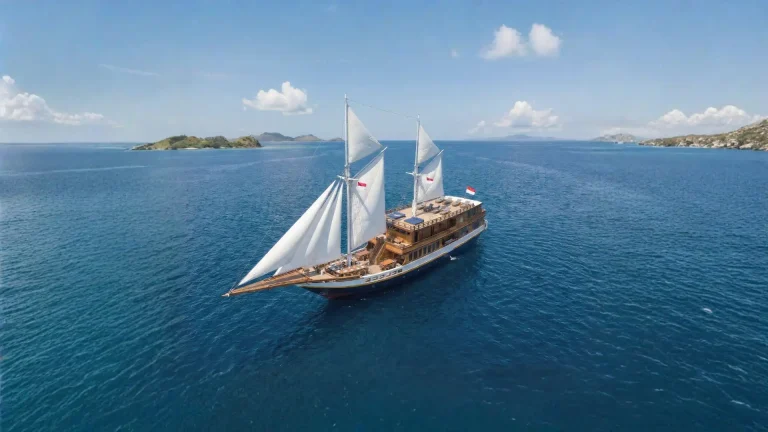
Sleeping on a boat in Komodo National Park means waking up in the exact bay where you want to be — Padar’s north cove before sunrise, Pink Beach before the day-trip boats arrive, or a remote anchorage near Gili Banta where you are almost certainly the only vessel. That is the honest promise of a private liveaboard charter departing from Labuan Bajo into the park. What follows is equally honest: what the cabins actually look and feel like, how rough the passages get, what the bathrooms are, and what to pack so none of it surprises you.
What a Night at Anchor Feels Like
Most anchorages inside Komodo National Park are calm. The park’s islands form a natural break between the Indian Ocean and the Flores Sea, so when you tuck behind Kalong Island for dinner or drop anchor in Gili Lawa Darat’s sheltered bay, the water is glassy. Meals happen on the open upper deck. You hear the water. The crew moves quietly. That is the typical Komodo liveaboard night.
Passages between islands are a different matter. The straits running through the park push serious tidal current — Komodo’s manta sites exist because the ocean is being squeezed through narrow channels, bringing cold, plankton-rich water to the surface. That same hydrography means crossings can be choppy. A phinisi or motor yacht cruising at 7–10 knots through a Beaufort 3–4 chop is not rough sailing, but it is movement. On longer passages — the crossing to Sangeang volcano, say, or the open-water leg to Satonda — the boat rolls. People who have never slept on a vessel in motion sometimes find this unsettling. People who have done it once almost always sleep through it the second night.
The best anchorages for genuinely flat nights (in dry-season conditions, April–October): Gili Lawa Darat’s protected bay, Kalong Island, Siaba Besar, and Pink Beach’s cove on calm days. South Komodo anchorages like Horseshoe Bay are accessed October–April when the northwest monsoon settles the sea; in July–August they are exposed to the southeast trades and operators rightly avoid them.
Is Komodo Sailing Rough? Seasons, Swell, and What to Expect
Komodo is not a gentle sailing destination in the way that the Mediterranean or Bali Strait can be. But it is not the Southern Ocean either. The honest seasonal picture:
- April–October (dry season)
- Calm north and central zones; July–August southeast trade winds kick up chop on exposed passages. Most anchorages in the main Komodo circuit remain sheltered. Best visibility underwater.
- November–March (wet season)
- Northwest monsoon settles the south coast — Horseshoe Bay, Manta Alley, and Cannibal Rock become accessible. Rain comes in bursts, rarely lasting more than an hour. January–February can produce heavier squalls; captains flex the day’s plan around BMKG forecasts.
- July–August specifically
- Peak tourist season and the breeziest time. Expect 15–20 knot SE trades on exposed north passages. A phinisi handles this well; guests feel it. We do not promise flat water in this window — we plan anchorages to minimise exposure.
One thing worth knowing: the Labuan Bajo harbour authority (KSOP Class III) issues suspension of sailing permits during BMKG extreme-weather warnings. This has happened — March 2024 and late 2025 are documented instances. It is uncommon, but a charter contract should explain the protocol when it does. Any credible operator will.
Seasickness on a Komodo Boat Trip: Real Tactics
Seasickness on a Komodo boat trip is a genuine concern for first-timers. The variables: tidal current, swell direction, individual susceptibility, time of day (early-morning passages on an empty stomach are hardest), and vessel size. A 55-metre luxury phinisi with stabilisers moves far less than a 22-metre mid-range boat in the same conditions. A rigid-hull inflatable tender bouncing through chop to a dive site is where most guests feel it first.
What actually works:
- Medication the night before. Dramamine (dimenhydrinate) or meclizine taken the evening before departure is more effective than a pill grabbed after you feel the first lurch. Scopoderm patches (scopolamine, prescription in most countries) are the gold standard for multi-day charters.
- Position on the boat. Midship, at water level, facing forward. The stern of a phinisi at anchor is the worst place. The covered upper deck facing forward is close to ideal.
- Eat before passages, but lightly. An empty stomach amplifies nausea. Rice, bread, anything starchy. Avoid coffee and dairy on rough-passage mornings.
- Fix your eyes on the horizon. This sounds like a cliché because it works. Staring at a phone or a book below deck accelerates the mismatch between what your eyes see and what your vestibular system feels.
- Fresh air. Below deck in a closed cabin with engine noise and heat is the worst combination. Get on deck.
- Ginger. Ginger sweets, ginger tea — bring a supply. The Labuan Bajo markets stock them; we always recommend guests pack some. The science is real, the convenience matters.
Most guests who arrive anxious about motion sickness find that the anchorage nights are perfectly still, that the passages between sites are short (Kelor to Rinca is under two hours; Rinca to Kalong is under an hour), and that by day two their bodies have adjusted. It is genuinely rare for seasickness to derail a Komodo charter. It does happen, and we will not pretend otherwise.
Do Komodo Boats Have Air Conditioning? Cabins by Vessel Class
Whether air-conditioned cabins are included on a Komodo liveaboard depends entirely on the vessel class you book. This is the single most important line to read in a charter quote.
| Vessel Class | Typical AC Situation | Private Bathrooms | Cabins / Guests | Per-Night Range (last verified June 2026) |
|---|---|---|---|---|
| Budget wooden / semi-phinisi | Partial or fan only — not guaranteed | Often shared (1–2 bathrooms for all cabins) | 2–4 cabins, 4–10 guests | ~USD 1,200–2,500/night (implied from trip packages) |
| Mid-range phinisi | AC standard in each cabin; older boats may have weaker units | Mix of ensuite and shared; new builds increasingly all-ensuite | 3–6 cabins, 6–14 guests | ~USD 2,500–8,000/night |
| Luxury phinisi | Full AC, individually controlled | All ensuite, standard | 5–9 cabins, 8–18 guests, 10–21+ crew | ~USD 8,000–30,000/night |
The market in and around Labuan Bajo has moved quickly. Mid-range phinisi built in the last three to four years are almost always all-ensuite; older vessels of the same class may not be. Always ask, and get the answer in writing before signing. For honeymoon charters, our standard recommendation is to stipulate “ensuite bathroom and individual AC in every cabin” as a hard requirement — it eliminates ambiguity.
On budget boats, a ceiling fan and a shared bathroom are not signs of neglect; they are simply what the price buys. The sea views and the anchorages are the same. But if you sleep badly in heat, a budget boat in Komodo’s dry season can be genuinely uncomfortable. We would rather say that plainly before you book.
Toilets and Showers on Phinisi Yachts and Komodo Liveaboards
Toilets on Komodo boats are almost universally marine heads — vacuum-flush or electric. The rule everywhere in Indonesian waters: nothing but bodily waste and the provided single-ply toilet paper in the bowl. Wet wipes, sanitary products, anything else goes in the bin. This is not squeamishness; it is engineering. A blocked marine head in the middle of Komodo National Park on day three of a six-night charter is nobody’s preferred scenario.
Showers on phinisi yachts and Komodo liveaboards use freshwater from onboard tanks. The supply is generous on luxury vessels (daily replenishment via watermaker, adequate pressure, sometimes rainfall showers in the master cabin). On mid-range boats, crews ask guests to take shorter showers and avoid leaving taps running — a reasonable courtesy given that fresh water in a national park is exactly as finite as the tank gauge says. On budget boats, cold-water showers are common. Warm showers are a mid-range feature, not a given.
Private bathrooms on Komodo liveaboards are standard from mid-range upward. At the luxury tier, the ensuite is a proper bathroom — not just a shower and a toilet wedged into a corner. Prana by Atzaro (55 metres, 9 cabins, 18 guests, 21 crew) and comparable vessels at that tier have bathrooms that would not embarrass a boutique hotel. At the mid-range, expect compact but functional. At the budget tier, plan for shared.
WiFi and Phone Signal in Komodo National Park
Phone signal inside Komodo National Park is patchy at best, absent at worst. This is not a bug; it is the park. Komodo Island, Rinca, and the central anchorages are remote Indonesian waters. The nearest cell towers are in Labuan Bajo, roughly 40–90 kilometres away depending on where you anchor. Some towers on the outer islands provide intermittent 3G/4G; most do not.
What this means in practice:
- Indonesian SIM cards (Telkomsel has the best rural coverage in Flores) may pick up signal near the park entrance or on the northern edge near Gili Lawa. Inside the core park — no reliable signal.
- Satellite messaging (Garmin inReach, Iridium) is how captains communicate weather data and emergencies. Not something guests need to bring, but worth knowing the vessel has it.
- WiFi on boat depends on whether the vessel has a Starlink terminal or satellite broadband. Some luxury-class phinisi and motor yachts now carry Starlink; a handful of mid-range boats do too. Verify per vessel before you book — it is not universal and the speeds vary with satellite coverage.
- On vessels without Starlink, expect social-media-grade uploads to be impossible inside the park. Download everything you need before departure from Labuan Bajo.
Can You Work Remotely on a Komodo Liveaboard?
Short answer: reliably, no. Not inside the national park on most vessels. If a Starlink connection is confirmed on the boat and you have verified it works in this corridor (ask the operator for a screenshot of actual speeds at anchor in the park — not a brochure claim), then light email and messaging may be possible. Video calls are a gamble. Real-time collaboration tools that need sustained upload bandwidth will drop out.
The more interesting question is whether you want to work remotely on a Komodo liveaboard. A four-night charter from Labuan Bajo into the park — Padar at sunrise, pink sand at midday, manta rays at slack tide, the flying-fox exodus at Kalong — is not a place that benefits from a laptop open on the sundeck. That is an editorial opinion, not a policy. But we have designed a lot of these itineraries, and the guests who try to half-work consistently regret the half-work and not the charter.
If connectivity matters to your group, the practical solution is: base yourself in Labuan Bajo at a hotel with reliable WiFi for the working days, then join the boat for the evenings or start the charter after your last call. We can build that into the plan. Design your charter with the concierge team and tell them the connectivity constraint — they will sequence the days accordingly.
Stay in Labuan Bajo or Sleep on the Boat? An Honest Comparison
This comes up in almost every first-time planning conversation. Labuan Bajo has good hotels now — the Ayana and similar properties command strong views, reliable WiFi, proper gym facilities, restaurant variety. So the question is legitimate: why sleep on the boat when you can sleep in a hotel and do the park as day trips?
The answer is access. Day trips from Labuan Bajo to Padar take three to five hours one way by public boat or fast boat. By the time you arrive, a dozen other boats have already landed for the sunrise trek. The Padar you see from a liveaboard is a private hillside at 5:30 a.m. with no other visitors; the Padar you see on a day trip is a busy viewpoint platform with a queue. Pink Beach before 7:00 a.m. is a different place from Pink Beach at 10:00 a.m. These are the concrete reasons the park experience is better when you sleep inside it.
The cases where staying in Labuan Bajo makes more sense:
- You have young children under five who do not sleep well outside their home environment.
- A member of the group has a serious motion-sickness history and has not tested medication.
- The trip is one or two days, budget is limited, and you want to see the park at any cost — a day trip is a valid way to do that.
- You are working, genuinely, and need consistent connectivity for part of the trip.
For most travelers — couples, families with children over six, divers, photographers, anyone whose goal is seeing the park properly — sleeping on the boat inside Komodo National Park from Labuan Bajo is the better choice. The logistics and the discomfort questions that fill planning forums are almost always smaller than they appear once you’re there.
What to Pack for a Komodo Boat Trip
A private charter from Labuan Bajo into the park is fully crewed and fully catered — three meals a day plus snacks, all drinking water, tea, and coffee. The crew handles linen, towels, and basic sundries. What you carry yourself should be compact. Phinisi cabins are generous but not luggage-storage units.
The Non-Negotiables
- Reef-safe sunscreen. Regular sunscreen leaches into the water at every entry point. The reef at Manta Point and Batu Bolong is the reason you are there. Bring enough reef-safe formula for daily reapplication.
- Seasickness medication. Bring your choice even if you have never been seasick. First time in Komodo current is not when you want to experiment.
- Rash guard or UV-protection shirt. You are in the water or on deck for six to eight hours a day. A rash guard is more practical than repeated sunscreen application.
- Dry bags. Your phone and camera go into tenders, onto beaches, and occasionally onto damp decks. Two small dry bags — one for each — are the most used items on any charter.
- Headlamp or small torch. For pre-dawn Padar treks and moving around a darkened boat at night without waking the cabin next door.
- Prescription medication in carry-on quantities. Pharmacies in Labuan Bajo are limited. Bring extras.
- A light layer for night passages. A cotton hoodie or thin windbreaker. After sunset in the park, with the engine off and the stars visible, it gets cooler than guests expect.
Useful to Have
- Underwater camera or GoPro with a wrist mount. The crew provides snorkel gear; they do not provide cameras. Manta rays at Karang Makassar are a photograph you will want.
- Ginger supplements or ginger sweets. Natural anti-nausea. Also useful for queasy tender rides.
- Sandals that dry quickly. Tevas or equivalents. You are stepping on and off the boat multiple times a day. Anything that needs to air-dry overnight has one job.
- E-reader loaded before departure. No signal, long evenings at anchor, beautiful light. This is the ideal reading holiday that people discover by accident.
- Small personal first aid kit. Not because the boat lacks one — it will have one — but because your own antihistamines, blister plasters, and electrolyte sachets for post-dive rehydration are convenient to have in your cabin.
Leave at the Hotel
- Hard-shell suitcases. Soft bags that compress under the bed are standard advice from every charter crew in Komodo.
- Formal clothes. The dress code on a Komodo charter is swimwear, light layers, and reef shoes. Leave the blazer at the Labuan Bajo hotel.
- Valuable jewellery. Salt air and small spaces.
Snorkel masks and fins are included on all vessel classes. Full scuba equipment — BCD, regulator, wetsuit — varies; luxury phinisi typically carry a full dive kit, while mid-range boats often provide tanks and a compressor but expect guests to bring regulators and BCDs, or rent from a Labuan Bajo dive shop the day before departure. Confirm this specifically when you book. It is the detail that most first-time divers forget to ask about.
A Note on Budgeting for Your Nights in the Park
The private charter market from Labuan Bajo into Komodo National Park runs roughly USD 3,000–30,000 per night for the whole boat, depending on vessel class, season, and number of cabins (last verified June 2026). The market quotes per-trip packages rather than clean nightly rates, so all per-night figures are implied from package math.
A worked example: a mid-range phinisi at USD 4,000 per night on a 3-night charter (3 days, 2 nights) comes to USD 12,000 for the boat before park fees. Komodo National Park entrance fees for foreign visitors run IDR 250,000 per person per day (travel-site consensus; verify at booking, last verified June 2026), so a group of four adds roughly USD 65–70 per person per visit day on top. Park fees, ranger fees, and diving surcharges are typically not bundled into mid-range charter rates — confirm the line items with your operator.
No one can pay to influence what we publish here. If you proceed with a partner or operator through our planning service, they may pay us a referral fee at no extra cost to you — that is the funding model for this free guide.
Ready to price a specific itinerary or vessel class? Our concierge team at Indonesia Juara (sister brand within Juara Holding Group, disclosed) builds private charters from Labuan Bajo into Komodo National Park from 2 nights to 14 nights. Contact us via our charter brief form or WhatsApp — the planning conversation is free, and the first thing we will ask is how you sleep, not how many sites you want to see.
Frequently Asked Questions
Do all Komodo liveaboards have air conditioning in the cabins?
No. Air-conditioned cabins on a Komodo liveaboard are standard from mid-range phinisi upward, but budget wooden boats and older semi-phinisi often have ceiling fans only or partial AC in select cabins. If AC is a comfort requirement, specify it explicitly in your charter brief and verify it is individual in each cabin — not just in a shared lounge. Luxury-class vessels (roughly USD 8,000–30,000 per night) have individually controlled AC as a baseline.
Are there private bathrooms on Komodo liveaboards?
Private ensuite bathrooms are standard on mid-range phinisi and all luxury-class boats. Budget boats typically have one or two shared bathrooms for the entire guest group. For a honeymoon or any trip where privacy matters, stipulate “ensuite for every cabin” before booking. New-build mid-range phinisi launched in the last three to four years almost always meet this standard; older boats of the same price range may not.
Is there WiFi or phone signal inside Komodo National Park?
Mobile signal inside Komodo National Park is unreliable to absent. The park sits far from cell infrastructure in Flores, and most core anchorages have no coverage. Some luxury phinisi and a small number of mid-range vessels now carry Starlink satellite internet — speeds and reliability vary. If connectivity matters, ask the operator for documented evidence of Starlink availability on the specific vessel (not a general fleet claim) and verify coverage in park waters before confirming the booking. Do not count on signal for anything time-sensitive.
What should I take for seasickness on a Komodo boat trip?
Take medication the evening before departure, not after symptoms start — meclizine or dimenhydrinate (Dramamine) are widely available; scopolamine patches require a prescription and are the most effective option for multi-day charters. Ginger supplements genuinely help. Sit midship facing forward during passages, eat lightly before crossings, stay on deck and fix your eyes on the horizon. Most first-timers are fine after the second day as their bodies adjust. The worst passages are early-morning open-water crossings on an empty stomach — these can be avoided with route planning if motion sickness is a serious concern.
Is it better to stay in Labuan Bajo at a hotel or sleep on the boat in Komodo?
For the full Komodo National Park experience, sleeping on the boat wins. The park’s best moments — Padar at sunrise, Pink Beach before the day-trip crowd, manta drift at slack tide in an empty channel — require being inside the park before and after those windows. Day trips from Labuan Bajo involve three-to-five-hour round transits each way and arrive at sites already busy. The cases where a hotel base makes sense: very young children, confirmed severe motion sickness, or a short trip where budget constraints make a day trip the only viable option.