Rinca or Komodo Island for Dragons? What Charter Guests Should Choose
Rinca or Komodo Island for dragons? Compare Loh Buaya vs Loh Liang trek distances, sighting odds, and how a private charter from Labuan Bajo does both.
12 min read
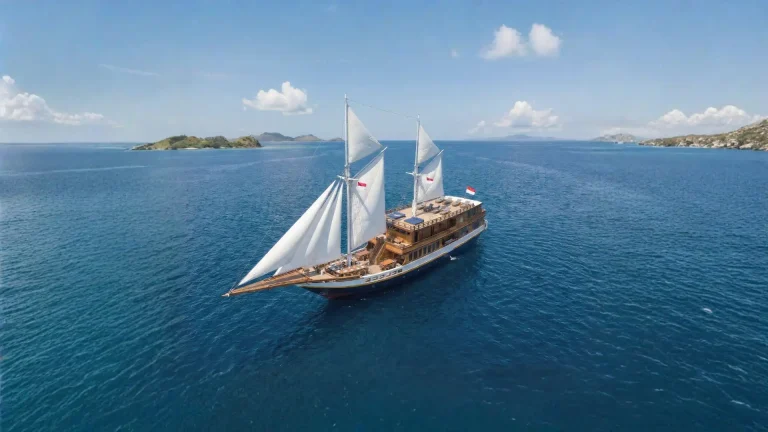
When guests ask about komodo dragons — Rinca or Komodo Island — the honest answer is that both ranger stations deliver real, close-range sightings under calm conditions, but they serve different moments in a charter. Loh Buaya on Rinca sits roughly 1.5 to 2.5 hours from Labuan Bajo by phinisi, making it the natural first-day stop. Loh Liang on Komodo Island is 4 to 5 hours out — typically saved for Day 2 or 3. On any trip of three days or more departing from Labuan Bajo into Komodo National Park, you visit both. The question is not which one to choose but how each fits the rhythm of your charter.
Loh Buaya, Rinca: The Closer, Denser Encounter
Rinca is where most guests see their first dragon, and the impression is rarely subtle. The walk from the ranger station at Loh Buaya to the main congregation area is short — under twenty minutes on the standard loop — which suits guests who are not keen on long treks in midday heat. The real draw is density. The kitchen area near the ranger post is where dragons rest in numbers; a single morning visit can put you within the ranger-regulated minimum distance of six to ten large adults without covering much ground at all.
The island itself is smaller and more open than Komodo, with savannah grassland rather than monsoon forest. Sightlines are long. Dragons move across open ground, and you can watch them from a distance before the ranger closes the gap to a respectable but genuinely close vantage. That openness also means the walk back is cooler in a relative sense — there is wind off the Flores Sea most mornings.
For guests asking about seeing komodo dragons without extensive hiking, Loh Buaya is the answer. The shortest circuit is under two kilometers. Rangers do offer longer forest routes for guests who want more time on land, but the core encounter — dragons, up close, no ambiguity — happens fast.
Sailing time from Labuan Bajo: approximately 1.5 to 2.5 hours on a phinisi or mid-range liveaboard, depending on conditions and vessel speed. A motor yacht trims that to under 90 minutes.
Loh Liang, Komodo Island: More Terrain, Different Energy
Komodo Island is larger, the terrain more varied, and Loh Liang ranger station sits at the edge of a bay that can hold a charter yacht overnight. The trekking circuits here range from a flat 30-minute loop around the station area up to a two-hour ridge walk through dense dry forest. That variety suits mixed groups: confident walkers take the long route while those who want a shorter option stay on the flat trail near the water point, where dragons gather in the morning shade.
How close can you get to komodo dragons at Loh Liang? The rules are identical to Rinca: rangers set a minimum approach distance, which varies by the dragon’s posture and location. Experienced rangers read behaviour well. You will not be kept at a frustrating distance — close enough to see the forked tongue working the air is standard practice — but the ranger controls the encounter, not the guest. That is the right arrangement, and sensible guests appreciate it once they see how fast a large adult can move when motivated.
The longer trails on Komodo Island also pass through habitat where deer and wild boar move, giving the walk a broader wildlife character. Some guests find this more immersive than Rinca’s shorter loops; others simply want dragons and are happy with the quicker Rinca experience. Neither preference is wrong.
Sailing time from Labuan Bajo: approximately 4 to 5 hours on a phinisi. This is why Loh Liang almost always falls on Day 2 or Day 3 of a charter — the vessel anchors overnight, often after stopping at Padar or Pink Beach, and the dragon trek happens on a fresh morning.
Side-by-Side Comparison
| Factor | Loh Buaya (Rinca) | Loh Liang (Komodo Island) |
|---|---|---|
| Distance from Labuan Bajo | ~1.5–2.5 h by phinisi | ~4–5 h by phinisi |
| Shortest trek circuit | Under 2 km, flat to gentle | ~1.5 km flat loop near station |
| Longest option | ~3–4 km forest/savannah | ~5–6 km ridge trail |
| Dragon density at station | High — kitchen area concentration | Moderate — more dispersed |
| Terrain character | Open savannah, long sightlines | Mixed forest and savannah |
| Overnight anchorage | Possible; bay is sheltered | Yes — Loh Liang bay, calm |
| Best for short-walk guests | Strong choice | Flat loop available but less central |
| Ranger fee (last verified June 2026) | IDR 200,000 per group ≤5 pax | IDR 200,000 per group ≤5 pax |
| Park entrance (last verified June 2026) | IDR 250,000/foreign visitor/day; verify at booking | IDR 250,000/foreign visitor/day; verify at booking |
Park fee figures sourced from travel-site consensus, not official decree — verify at booking. Last verified June 2026.
When Are Komodo Dragons Most Active?
The honest answer: mornings, always. Both ranger stations recommend arriving early — before 09:00 if possible — when air temperatures are cooler and dragons move more freely. By 11:00 the heat drives them into shade, and a large adult in deep shade under a tree offers a less dynamic encounter than one crossing open ground in the early light.
What time of year are komodo dragons most active? Dragons are present year-round — this is not a migratory species and both stations operate every day the park is open. The behavioral shift that most guests notice is during July and August, when mating season peaks. During those months, males spar more visibly, and rangers report more movement around water points and open areas. That said, July and August are also the park’s busiest months, so visitor numbers at both stations are higher. If you want the mating-season behavior without the crowds, the shoulder months of May–June and September offer a reasonable compromise: drier weather, longer daylight, and calmer anchorages, with some mating activity still visible.
The wet season (December–March) brings fewer visitors to both stations. Sightings remain reliable — dragons do not hibernate — but the terrain is muddier and some charter routes adjust for sea conditions. January and February carry the roughest seas on average.
Padar Island vs Rinca: A Different Question Entirely
Guests sometimes frame this as Padar Island vs Rinca, as if both serve the same purpose. They do not. Padar is a viewpoint destination — a 45 to 60-minute ridge walk to a panorama of three bays and a horizon of islands that earns its place on every itinerary. There are no dragons on Padar. Rinca is a wildlife encounter. Both belong on the same trip, typically on the same day or consecutive days, and comparing them as alternatives misses the point of each.
On a 3-day 2-night charter from Labuan Bajo, Day 2 commonly runs: pre-dawn sail to Padar for sunrise, trek the ridge, sail to Komodo Island for the Loh Liang dragon trek in the afternoon. That pairing — Padar summit in the morning, dragons at Loh Liang in the afternoon — is one of the most satisfying sequences the park offers. The two stops complement rather than compete.
How a Private Charter Changes the Dragon Experience
A komodo dragon tour on a private boat operates on your schedule, not a shared-boat departure time. That matters for two practical reasons.
First, you arrive when you want to. Booking the first morning slot at Loh Buaya or Loh Liang means you beat the shared day-trip boats that cluster at the jetty around 09:00–10:00. Rangers at both stations confirm that the early window — anchoring overnight and walking at first light — produces quieter, less pressured encounters.
Second, you are not rushed. Shared tours allocate a fixed time per stop. On a private yacht charter from Labuan Bajo, if the dragon encounter is particularly good — a large adult hunting, or a nest guarded by a female — the ranger can extend the time. Your cook keeps lunch. The boat waits.
Park entry is managed through the SiORA (Sistem Informasi Online Reservasi Wisata Alam) e-ticketing system. Walk-in tickets are no longer available; advance booking is required. A reported 1,000-visitor daily cap exists, though this figure comes from a single source as of June 2026 — your operator handles the permit logistics as part of the charter briefing.
Which Dragons Do You See, and How Close?
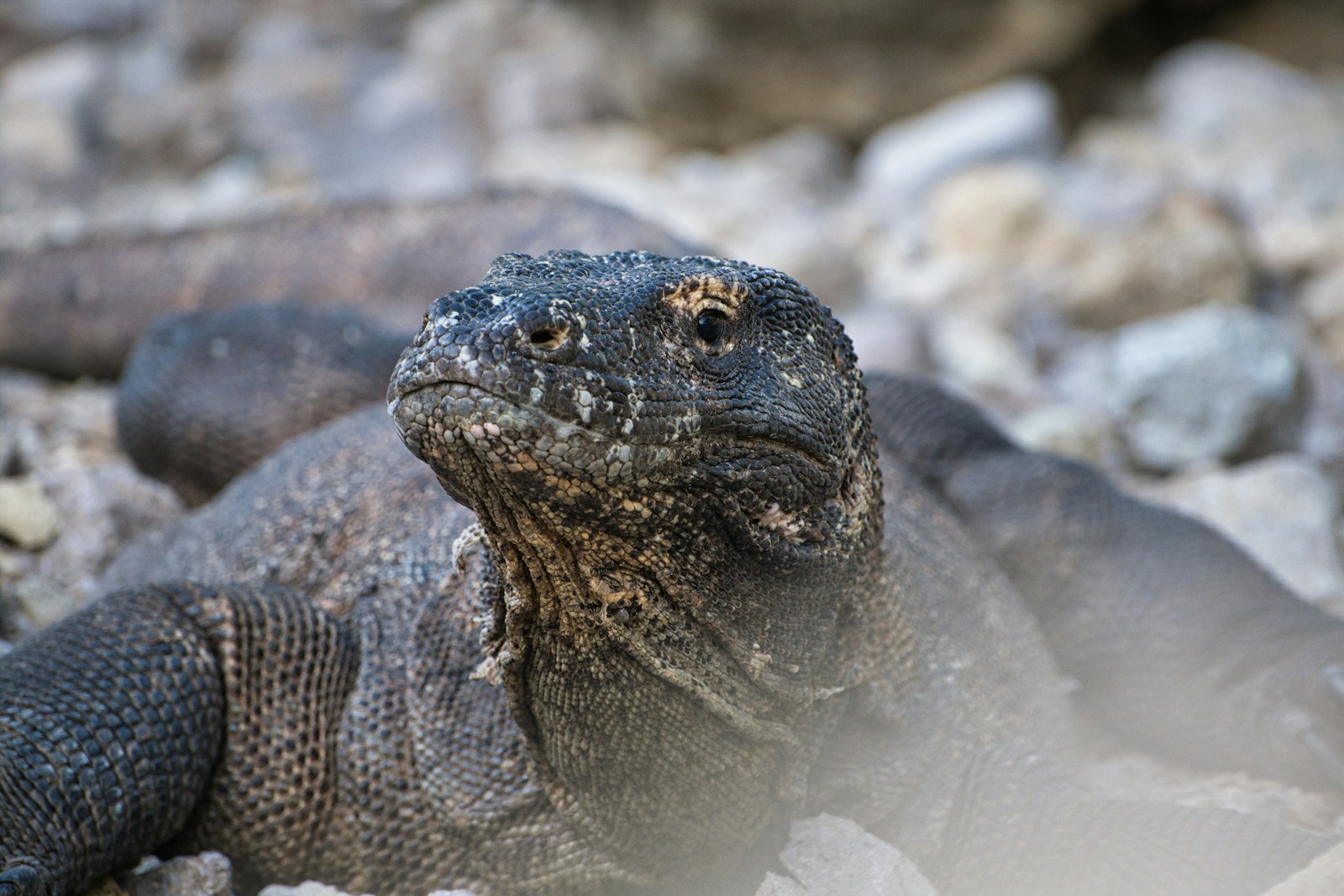
Varanus komodoensis — the Komodo monitor, the world’s largest living lizard — is the animal at both stations. Adults reach 2.5 to 3 meters in length and 70 kilograms. The size is arresting in person in a way photographs do not convey. Both ranger stations have habituated populations that tolerate a steady approach to within a few meters, managed by the ranger’s forked stick and positioning awareness.
Sightings at both locations are likely but not guaranteed. This is a wild animal in a national park. The rangers have a strong track record, and guests who arrive at dawn on most days of the year will encounter dragons. The candid version: some mornings produce six adults in the first twenty minutes; other mornings produce one juvenile and a long wait. Weather, season, and the specific movement of the local population all play a role. Booking both stations — Rinca on Day 1, Komodo Island on Day 2 or 3 — doubles the encounters and the odds.
If mobility is a concern for any guest in your group, speak with the concierge before departure. Both stations have shorter flat options, but the terrain around the ranger posts is unpaved and uneven in places. A guide briefing beforehand sets realistic expectations and lets the ranger assign the route best suited to the group.
The Case for Doing Both on a 3-Night Charter
The 3-day 2-night format from Labuan Bajo is designed around exactly this question. Day 1 covers Kelor Island and Rinca (Loh Buaya) — a compact, high-density dragon encounter in the afternoon, with the boat anchoring at Kalong Island for the dusk flying-fox exodus. Day 2 opens with a Padar sunrise trek, then sails to Komodo Island’s Loh Liang for the afternoon dragon walk, continuing north to Gili Lawa Darat for sunset and anchoring in the bay. Day 3 adds Karang Makassar manta drift and Taka Makassar sandbar before the afternoon return to Labuan Bajo.
That loop costs two nights. Charter rates for a private phinisi run from approximately USD 3,000 to 30,000 per night depending on vessel class, last verified June 2026 — so a 3-day 2-night trip on a mid-range phinisi sits around USD 6,000 to 16,000 before park fees and taxes. A worked example: 2 nights at USD 4,000 per night equals USD 8,000 charter cost, plus park entrance (IDR 250,000 per foreign visitor per day, verify at booking), ranger fees (IDR 200,000 per group per trek), and any fuel or provisioning supplements as noted in your quote.
For guests who cannot manage two nights, the 2-day 1-night format covers Rinca only — the closer station, the denser encounter. It is a strong trip. But the full picture, both islands, Padar at dawn, requires at least two nights on the water.
Ready to plan a dragon-focused itinerary around your group and schedule? Design your charter with our concierge team, or send the key details — party size, dates, and how many nights you have — via WhatsApp for a same-day response.
Frequently Asked Questions
Is Rinca or Komodo Island better for seeing dragons?
Both deliver reliable sightings under good conditions, and neither is objectively superior. Rinca (Loh Buaya) is closer to Labuan Bajo — about 1.5 to 2.5 hours by phinisi — and the concentration of dragons near the ranger station kitchen area tends to be higher. Komodo Island (Loh Liang) is further out and has longer trail options, but also a sheltered overnight anchorage that suits a multi-night charter. The practical answer for most guests: do both, starting with Rinca on Day 1 and Komodo Island on Day 2 or 3.
When is the best time to see komodo dragons in Komodo National Park?
Early morning, year-round. Arrive at the ranger station before 09:00 when the air is cooler and dragons move more actively. July and August are mating season, which produces more visible sparring behavior among males — but those months also bring the largest visitor numbers. The dry season from April through October offers the most stable sea conditions for reaching both stations; the shoulder months of May–June and September are a particularly good balance of dragon activity, calm seas, and manageable crowds.
How close can you actually get to komodo dragons?
Consistently within a few meters, managed by your assigned ranger. Both Loh Buaya and Loh Liang rangers position guests at distances that allow clear, close observation without provoking the animal. The ranger carries a forked stick and reads the dragon’s posture throughout the encounter. Guests should follow instructions without exception — large adults can cover ground faster than most people expect. No guest may approach independently.
Can I see komodo dragons without doing a long hike?
Yes. Both stations offer short flat circuits under two kilometers. At Loh Buaya on Rinca, the kitchen-area concentration means many groups see their best dragon encounter within the first ten to fifteen minutes of the walk. At Loh Liang on Komodo Island, a flat loop near the station is available. Speak with the concierge when briefing your charter so the ranger assigns the appropriate route for your group’s mobility.
Does a private charter yacht from Labuan Bajo make a difference for the dragon experience?
Meaningfully, yes. A private boat sets its own departure time, allowing you to arrive at first light before shared day-trip groups. You are not on a group schedule, so if the ranger finds an active encounter — a hunt, a sparring match, a large female near a nest — the stop extends. The boat waits. Overnight anchorage at Loh Liang bay also means the morning trek happens in the first cool hours of the day rather than in mid-morning heat after a long transit from the jetty. If you want the dragon encounter at its best, the private-charter timing advantage is real.